
Chitosan vs. Kaolin Hemostatic: Which Belongs in Your Kit?
Chitosan stops bleeding mechanically by attracting red blood cells. Kaolin accelerates the start of the clotting cascade. The right civilian choice depends on who's using it, where, and on what kind of bleed.
Reviewed by Inspiration Medical Technology, Inc. All articles are reviewed for accuracy and brand-voice compliance by the team behind AllaQuix®. Not a substitute for medical advice from your doctor.
The short answer
Both chitosan and kaolin are FDA reviewed and cleared hemostatic agents used in military, EMS, dermatology, and OTC civilian first aid. They stop bleeding in fundamentally different ways. Chitosan is positively-charged and physically binds red blood cells to form a seal. Kaolin activates Factor XII at the start of the clotting cascade.
The civilian distinction that matters most: chitosan works independently of your clotting cascade, so it's effective for people on blood thinners, people with bleeding disorders, and anyone who normally has trouble stopping bleeding. Kaolin needs an intact cascade to work.
Quick verdict
- Kaolin (QuikClot® CombatGauze and similar) speeds up a clotting cascade that already works
- Chitosan (AllaQuix® High-Performance) works mechanically, so it does not need that cascade. That makes it the right pick for blood thinners, bleeding disorders, and harder bleeds
- Calcium alginate (AllaQuix® Lite) is the gentler everyday option for small cuts and fragile skin
- If anyone in the household has a reason for impaired clotting, the mechanism question is the whole decision
How chitosan works
Chitosan is a biopolymer derived from shellfish exoskeletons. The processed fibers carry a positive electrical charge while red blood cells carry a negative charge. When the chitosan gauze contacts a bleeding wound, the fibers attract red blood cells and bind them to the dressing, forming a physical seal over the wound.
Because the seal is mechanical and the dressing does not depend on platelet activation or coagulation factors, chitosan continues to work on people whose clotting cascade is impaired. That's why it's been the U.S. Military standard for combat hemostasis for over two decades, including in patients who have lost large volumes of blood and whose own clotting may have started to fail.
How kaolin works
Kaolin is a naturally-occurring clay mineral. Kaolin-impregnated gauze activates Factor XII (the Hageman factor) at the start of the intrinsic clotting cascade, accelerating the body's own clot-formation pathway.
Because kaolin relies on the cascade to do the work, it depends on the patient having functional clotting factors and platelets. In a healthy civilian with intact clotting, kaolin is fast and effective. In a patient on anticoagulants, with hemophilia or von Willebrand disease, or experiencing severe trauma-induced coagulopathy, kaolin may be less effective than chitosan.
COMPARISON
Chitosan vs. kaolin: side-by-side
| Chitosan · AllaQuix® High-Performance ★ | Kaolin · QuikClot® CombatGauze and similar | |
|---|---|---|
| Mechanism | Mechanical: attracts red blood cells, forms a physical seal | Biochemical: activates Factor XII at the start of the clotting cascade |
| Works on blood thinners | Yes, independent of the cascade | Reduced effectiveness on warfarin, DOACs, antiplatelets |
| Works with bleeding disorders | Yes (hemophilia, VWD, thrombocytopenia) | Reduced effectiveness when cascade or factors are impaired |
| U.S. Military use | Yes, primary chitosan hemostat | Yes, primary kaolin hemostat (CombatGauze) |
| FDA status | Reviewed and cleared for OTC | Reviewed and cleared for OTC |
| Shellfish allergy concern | Processing removes animal protein, minimal risk | No shellfish concern |
| Heat reaction risk | None | None (modern kaolin formulations) |
| Sold by AllaQuix® | Yes, High-Performance is our chitosan line | No, we do not sell a kaolin dressing |
WHAT WE MAKE INSTEAD
AllaQuix® does not sell kaolin. Here is what we do sell.
Kaolin needs your clotting cascade to work. We build around dressings that do not make that assumption: chitosan for harder bleeds, calcium alginate for everyday ones.
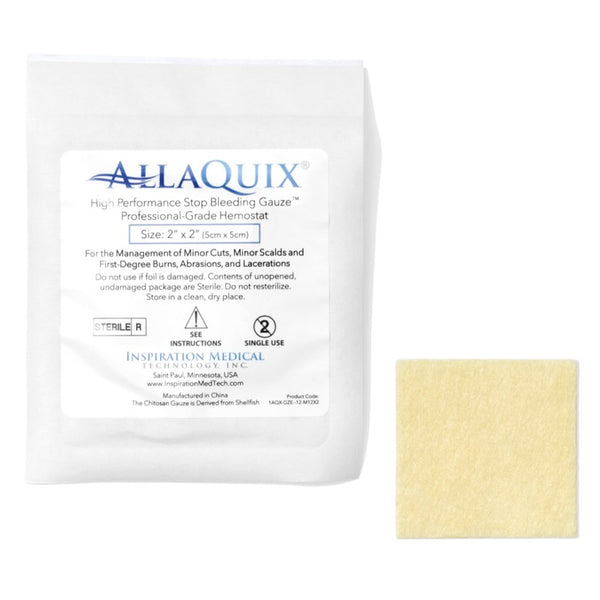
CHITOSAN
AllaQuix® High-Performance 2 × 2
The chitosan option. Attracts red blood cells to form a mechanical seal, independent of your clotting cascade. Sold in 10 and 20 packs.
Best for: blood thinners, bleeding disorders, harder bleeds

CALCIUM ALGINATE
AllaQuix® Lite Gauze 2 × 2
The everyday option. Calcium alginate gauze that absorbs up to 20 times its weight and gels over the wound. Hypoallergenic and gentle on thin or fragile skin. Box of 20.
Best for: small cuts, sensitive skin, daily nuisance bleeds
Which one for a civilian EDC kit
For everyday-carry kits intended to handle the cuts you'll actually encounter (kitchen knife slip, range injury, campsite laceration), either chitosan or kaolin works because the carrier is typically a healthy civilian with intact clotting. The decision usually comes down to logistics.
Chitosan packaging tends to be more compact and flexible, which makes it easier to fit into a glovebox kit or a small EDC pouch. AllaQuix® High-Performance 2×2 is the size most EDC users carry. Kaolin gauze tends to be bulkier in the standard z-fold combat format, which is built for packing a deep wound rather than covering a cut.
For EDC: AllaQuix® High-Performance 2×2
- Compact 2×2 packaging fits a glovebox kit
- 10 or 20-pack flip-top box
- Works the same whether or not the person bleeding is on a blood thinner
- Pair with AllaQuix® Wrapid to secure on a moving body part
- Add AllaQuix® BurnEase for burn coverage
Which one for a home first-aid drawer
For the home first-aid drawer, the decision is easier. If anyone in the household takes a blood thinner (warfarin, Eliquis, Xarelto, Pradaxa, daily aspirin), has a bleeding disorder, or is over 65 with thin skin, choose chitosan. The mechanism advantage matters.
Most of what a home drawer actually handles is not dramatic: a shaving nick, a torn skin tear, a finger caught on a can lid, a spot that keeps weeping after a scratch. That is calcium alginate territory. AllaQuix® Lite gels on contact, absorbs up to 20 times its weight, and lifts off without tearing thin skin. Keep High-Performance behind it for the bleed that does not want to stop.
For the home drawer: keep both sizes of the problem covered
- AllaQuix® Lite 2×2 for everyday cuts, fragile skin, and weeping wounds
- AllaQuix® High-Performance 2×2 for the harder bleed, blood thinners, or a bleeding disorder
- Neither one asks whether your clotting is working the way kaolin does
Final thoughts + next steps
The chitosan vs. kaolin debate has been settled for the high-trauma military and EMS use case in different directions depending on the protocol. For civilian OTC use, the brand name matters less than the practical question: does anyone in the household have any reason to have impaired clotting? If yes, chitosan. If no, either.
To be straight with you: AllaQuix® does not sell a kaolin dressing, and that is a deliberate choice rather than a gap. Kaolin works by accelerating the clotting cascade, which means it quietly assumes the person bleeding still has a working one. That is exactly the wrong assumption for the people we build for: anticoagulant patients, bleeding disorders, thin and fragile skin. So we make chitosan (High-Performance), which forms a mechanical seal and does not depend on that cascade, and calcium alginate (Lite), which gels and absorbs for everyday bleeds. Both are FDA reviewed and cleared for OTC use, no prescription required.
READY WHEN YOU ARE
Add one to your kit
High-Performance for the bleeds that are hard to stop. Lite for the everyday ones.
CHITOSAN
AllaQuix® High-Performance 2 × 2
The chitosan option. Attracts red blood cells to form a mechanical seal, independent of your clotting cascade. Sold in 10 and 20 packs.
Best for: blood thinners, bleeding disorders, harder bleeds
CALCIUM ALGINATE
AllaQuix® Lite Gauze 2 × 2
The everyday option. Calcium alginate gauze that absorbs up to 20 times its weight and gels over the wound. Hypoallergenic and gentle on thin or fragile skin. Box of 20.
Best for: small cuts, sensitive skin, daily nuisance bleeds
FAQ
Common questions on this topic
Is chitosan or kaolin better for civilian first aid?
For most civilian use cases, chitosan is the more versatile choice because it works mechanically and is independent of the clotting cascade. That means it works for people on blood thinners, people with bleeding disorders, and anyone over 65 with reduced clotting capacity. Kaolin is fast and effective for civilians with intact clotting, but it relies on the body's own cascade, which makes it less reliable across a household with varied health status. AllaQuix® makes the chitosan option (High-Performance) and a calcium alginate option (Lite) for everyday bleeds; we do not make a kaolin dressing.
Can I use chitosan gauze with a shellfish allergy?
Chitosan is derived from shellfish, but the deacetylation process removes the proteins responsible for allergic reactions. A study in Military Medicine found that subjects with documented shellfish allergy tolerated the chitosan dressing without reaction. Anyone with a known severe allergy should still check with their doctor first.
Does the U.S. Military use chitosan or kaolin?
Both. The U.S. Military uses chitosan-based hemostats (the technology in AllaQuix® High-Performance) and kaolin-based hemostats (CombatGauze) depending on the protocol and the casualty. Chitosan's advantage is that it works mechanically, independent of the casualty's clotting status.
How long should I leave a chitosan dressing on?
Apply firm, steady pressure over the dressing for at least 10 to 15 minutes without lifting to check. Once bleeding is controlled, leave the dressing in place and cover it. For any wound that keeps bleeding after 15 minutes of steady pressure, or that spurts, seek medical care. Chitosan is for minor topical bleeding only.
Where can I buy chitosan or kaolin gauze without a prescription?
Both mechanisms are sold over the counter, no prescription required. Kaolin gauze is sold under brands such as QuikClot® CombatGauze through trauma and tactical retailers. AllaQuix® does not make a kaolin dressing. We make AllaQuix® High-Performance (chitosan) for harder bleeds and AllaQuix® Lite (calcium alginate) for everyday ones, both FDA reviewed and cleared for OTC use and available here on allaquix.com.
Why doesn't AllaQuix® sell a kaolin dressing?
Because kaolin's mechanism assumes something we can't assume about our customers. It accelerates the clotting cascade, so it needs the person bleeding to have functional clotting factors and platelets. A large share of the people who come to us are on warfarin, Eliquis, Xarelto, Pradaxa, or daily aspirin, or live with a bleeding disorder. Those are exactly the cases where that assumption breaks. So we make AllaQuix® High-Performance (chitosan), which forms a mechanical seal independent of the cascade, and AllaQuix® Lite (calcium alginate), which gels and absorbs for everyday cuts and fragile skin.
Put the right mechanism in your kit
Not for emergency, arterial, or severe bleeding. Patient education, not medical advice.
Dallas, Texas
FDA reviewed and cleared. Nearly one million AllaQuix® sold.