
Wound Care After Mohs Surgery: A 14-Day Home Playbook
What's normal, what isn't, and how to handle the late bleed at hour 30. A day-by-day guide for what to do with your Mohs surgery wound from the moment you leave the office through the two-week mark.
Reviewed by Inspiration Medical Technology, Inc. All articles are reviewed for accuracy and brand-voice compliance by the team behind AllaQuix®. Not a substitute for medical advice from your doctor.
What to expect when you leave the office
Your Mohs surgeon will send you home with a pressure dressing already applied. That dressing is usually a non-adhesive gauze pad held in place with stretch tape or an island dressing. The wound underneath has been closed with sutures, a flap, or left to heal by secondary intention, depending on the size and location.
Plan to be quiet for the rest of the day. Avoid bending over, lifting anything over 10 pounds, exercise, and alcohol. Keep your head elevated if the wound is on your face. Take Tylenol (acetaminophen) for pain. Avoid ibuprofen and aspirin for the first 48 hours unless your surgeon has cleared them, since both can raise the risk of a late bleed.
Stock before you leave the office
- AllaQuix® Basic island dressings: the small or 4×4 for face and scalp sites, the 4×6 or 4×14 for longer sites
- AllaQuix® High-Performance 4×4 for the surprise late bleed
- Sterile gauze pads
- Petrolatum (Vaseline) or Aquaphor
- Tylenol (not ibuprofen for the first 48 hours)
Keep the original dressing on
For the first 24 to 48 hours, your job is mostly to sit still. The original pressure dressing should stay on through the first night. If your surgeon's instructions say you can shower, the dressing may be waterproof or you may be asked to keep it dry.
If the dressing becomes saturated with blood within the first few hours, do not remove it. Apply additional gauze on top of the saturated dressing and press firmly for 15 minutes. If bleeding continues after 15 minutes of steady pressure, call your surgeon.
Clean and re-cover daily
At the 48-hour mark, you'll typically remove the original dressing and start the daily wound care routine: clean the wound with mild soap and water in the shower, pat dry, apply a thick layer of petrolatum or Aquaphor, and cover with a fresh adhesive dressing.
AllaQuix® Basic island dressings are sized for this exact use case. The small and 4×4 sizes work for face and scalp Mohs sites, the 4×6 works for chest and back, and the 4×14 covers longer flaps. The soft adhesive border holds through showers and daily activity without retraumatizing the surrounding skin on removal.
Daily routine
- Shower and rinse the wound with soap and water
- Pat the surrounding skin dry, leave the wound moist
- Apply petrolatum or Aquaphor (not antibiotic ointment)
- Cover with a fresh AllaQuix® Basic island dressing
- Change the dressing once a day until the wound seals
WHAT THIS ROUTINE NEEDS
The three products for post-procedure care
Everything in the 14-day routine above comes down to three things: something for the incision, something for daily cover, and something for the surprise bleed.
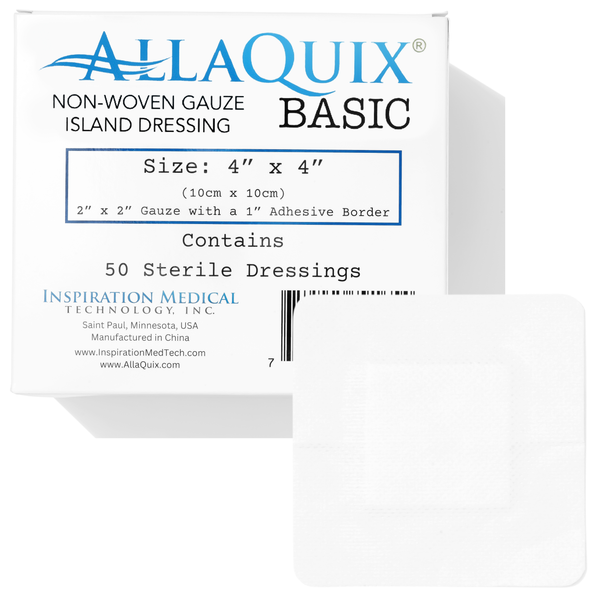
FOR THE INCISION
AllaQuix® Basic 4 × 4 Island Dressing
Sterile non-woven island dressing with a 1 inch adhesive border, so it sticks to skin and not to the wound. Latex-free and breathable. Also stocked in small, 4 × 6 and 4 × 14.
Best for: Mohs sites, longer incisions, post-procedure

FOR DAILY COVER
AllaQuix® Lite Bandage 2 × 2 (Box of 10)
Calcium alginate pad with adhesive on all four sides. Soft border, gentle to remove, and it helps the cut seal instead of just covering it.
Best for: IV sites, small biopsy sites, everyday cuts
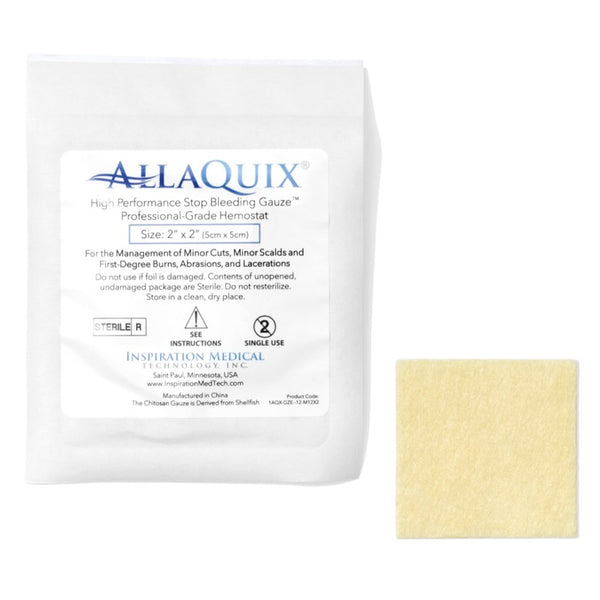
FOR HARDER BLEEDS
AllaQuix® High-Performance 2 × 2
Chitosan hemostatic gauze. Works by attracting red blood cells to form a seal, so it does not depend on your body clotting normally. The same technology used by the U.S. Military.
Best for: Deeper cuts, blood thinners, bleeding disorders
Continued protection
Most Mohs wounds seal at the surface within 7 to 10 days. The skin underneath is still rebuilding for weeks to months. During days 7 to 14, you can typically switch to a smaller adhesive bandage like AllaQuix® Bandages for daily coverage, and the larger Basic dressing becomes optional.
Avoid sun exposure on the wound for at least three months. Use SPF 50+ daily once the dressing comes off for good. Avoid strenuous exercise for the first two weeks if your surgeon hasn't cleared it.
Handling the surprise bleed at hour 24 to 36
A late bleed is when the wound starts bleeding again after the original pressure dressing was holding fine. It typically happens 24 to 36 hours after the procedure, often when the patient gets up to do something normal: bend over to tie a shoe, lift something heavy, take a hot shower. It can be alarming.
The fix is the same as for any bleed: apply firm, steady pressure to the wound through the dressing for 15 minutes without releasing. If the bleeding doesn't stop, place AllaQuix® High-Performance chitosan gauze directly over the wound, hold pressure for another 15 minutes, and call your surgeon's office.
Late bleed routine
- Apply firm, steady pressure for 15 minutes without releasing
- If bleeding continues, place AllaQuix® High-Performance on the wound
- Hold pressure another 15 minutes
- Call your surgeon's office during business hours, ER after
Pain and swelling management
Tylenol (acetaminophen) every 6 hours is the standard pain management for the first 48 hours. Avoid ibuprofen and aspirin for the first 48 hours unless your surgeon has explicitly cleared them, since both raise bleeding risk.
Ice packs for 20 minutes at a time during the first 24 hours help reduce swelling. After day 1, switch to warm compresses if the area feels tight. Keep your head elevated when sleeping for the first few nights if the wound is on your face.
When to call your surgeon
Most Mohs wounds heal without complications. Call your surgeon's office for any of the following: fever above 100.5°F, spreading redness extending more than half an inch from the wound edge, thick or foul-smelling drainage, pain that's getting worse rather than better, or bleeding that won't stop after 30 minutes of steady pressure.
Go to the ER for active bleeding that won't stop, a sudden, intense headache or vision changes (rare but possible after facial Mohs), or signs of an allergic reaction to a dressing such as hives, facial swelling or trouble breathing.
READY WHEN YOU ARE
Stock up before your procedure
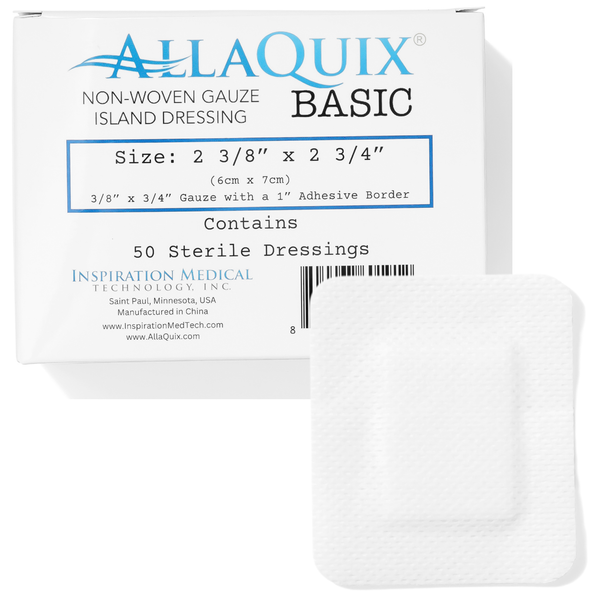
FOR SMALL FACE SITES
AllaQuix® Basic Small Island Dressing
The smallest Basic size, a soft non-adherent pad inside a 1 inch adhesive border. Sized for nose, ear and small facial Mohs sites. Box of 50.
Best for: Small facial and scalp sites
FOR THE INCISION
AllaQuix® Basic 4 × 4 Island Dressing
Sterile non-woven island dressing with a 1 inch adhesive border, so it sticks to skin and not to the wound. Latex-free and breathable. Also stocked in small, 4 × 6 and 4 × 14.
Best for: Mohs sites, longer incisions, post-procedure
FOR DAILY COVER
AllaQuix® Lite Bandage 2 × 2 (Box of 10)
Calcium alginate pad with adhesive on all four sides. Soft border, gentle to remove, and it helps the cut seal instead of just covering it.
Best for: IV sites, small biopsy sites, everyday cuts
FOR HARDER BLEEDS
AllaQuix® High-Performance 2 × 2
Chitosan hemostatic gauze. Works by attracting red blood cells to form a seal, so it does not depend on your body clotting normally. The same technology used by the U.S. Military.
Best for: Deeper cuts, blood thinners, bleeding disorders
FAQ
Common questions on this topic
What dressings should I use after Mohs surgery?
Your surgeon's office will send you home with the initial pressure dressing. For the daily routine after the first 48 hours, you want an adhesive island dressing sized to the wound that's gentle on the skin and stays put through showers. AllaQuix® Basic island dressings come in four sizes (small 2 3/8 × 2 3/4, 4×4, 4×6, and 4×14), so the dressing matches your wound. Also keep an AllaQuix® High-Performance chitosan gauze on hand for the surprise late bleed at hour 24 to 36, which is common and rarely warned about in standard post-op instructions.
Is it normal to have some bleeding 24 hours after Mohs surgery?
Some light bleeding or spotting in the first 24 to 48 hours is common. A small number of patients get a late bleed around hour 24 to 36. Reapply firm pressure for 15 minutes. Adding an AllaQuix® High-Performance chitosan dressing over the site can help. Then call your surgeon's office. Bleeding that spurts, or won't slow with firm pressure, needs urgent care.
When should I call my surgeon about post-op bleeding?
Call your surgeon's office if bleeding soaks through the dressing, doesn't stop after 15 minutes of steady pressure, restarts repeatedly, or if the site looks infected (spreading redness, pus, fever). Go to the ER for bleeding that spurts or won't slow with firm pressure. Always follow the instructions your surgeon sent home with you.
Can I shower after Mohs surgery?
Follow your surgeon's instructions. Most ask you to keep the original dressing on and dry for the first 24 to 48 hours, then resume gentle showering while keeping the site clean. After the first couple of days, clean the wound, pat dry, apply petrolatum, and re-cover with an AllaQuix® Basic island dressing sized to the site.
How long until a Mohs surgery wound fully heals?
Surface healing typically takes about two weeks, though deeper remodeling continues for months and varies by site and size. Plan to keep the site covered and protected for roughly 14 days. Your surgeon will give you a timeline specific to your wound.
Can I use a regular Band-Aid on a Mohs site?
A regular Band-Aid is usually too small and not gentle enough for a Mohs site. Use an adhesive island dressing sized to the wound, like AllaQuix® Basic, which has a soft adhesive border that holds through showers and peels off without retraumatizing the surrounding skin.
Try AllaQuix® before you buy
Not for emergency, arterial, or severe bleeding. Patient education, not medical advice.
Dallas, Texas
FDA reviewed and cleared. Nearly one million AllaQuix® sold.