
How to Stop Bleeding
Start here. Details and products are further down the page.
Do this nowWorks for most cuts, scrapes, and nosebleeds
Press firmly, directly on the wound
Use a clean cloth, gauze, or a shirt. Push down hard. It should feel like real pressure, not a light touch.
Hold for a full 15 minutes
Resist the urge to lift the cloth and check. Peeking pulls apart the clot that is forming, and you are back at the start.
Raise it above heart level
If it is an arm, hand, leg, or foot, lift it up while you keep pressing. Less blood reaches the wound.
Still bleeding? Add a hemostatic dressing
Place it directly on the wound and press again. It gives the wound something to clot against.
Step 2 · hold pressure this long
Keeps counting if you lock your phone
Call 911 or go to the ER right now if:
- Blood is spurting or pulsing out
- The wound is deep, gaping, or you can see fat or bone
- It is on the abdomen, chest, neck, or head
- Bleeding has not stopped after 15 minutes of firm pressure
- You cannot get the object out, or something is stuck in the wound
- The person is pale, faint, confused, or breathing fast
What actually stops bleeding, and what does not
There is a lot of advice online about kitchen-cabinet remedies. Some of it helps. Some of it is harmless but does nothing. And some of it can introduce bacteria straight into an open wound. Here is an honest read on each one.
| METHOD | DOES IT WORK? | WHAT TO KNOW |
|---|---|---|
| Direct pressure | Yes, first line | The single most effective thing you can do. Fifteen minutes of firm, uninterrupted pressure stops the large majority of minor bleeds on its own. |
| Elevation | Yes, with pressure | Raising the wound above heart level reduces blood flow to the area. Use it alongside pressure, never instead of it. |
| Hemostatic dressing | Yes | Chitosan and calcium alginate dressings give the wound something to clot against. Chitosan works mechanically, so it does not depend on your body clotting normally. |
| Cold water | Mild help | Rinsing cleans the wound and cold causes slight vessel constriction. Useful, but it is not a substitute for pressure. |
| Petroleum jelly | Limited | May help a forming clot stay put after bleeding has already slowed. Not useful on an actively bleeding wound. |
| Witch hazel | Limited | An astringent that may help a very minor nick. Little evidence for anything larger than a shaving cut. |
| Alum block or styptic pencil | Shaving nicks only | Genuinely useful for razor cuts. Not appropriate for anything bigger, and it stings. |
| Cayenne or black pepper | Not recommended | This one circulates widely online. Pepper is not sterile and pressing it into an open wound risks introducing plant material and bacteria. Any clotting benefit is outweighed by the infection risk. Use pressure instead. |
| Cornstarch, flour, or sugar | Not recommended | None of these are sterile. Flour in particular can carry pathogens. Putting them in an open wound risks a serious infection, and you will have to rinse the wound out afterward anyway. |
| Antiperspirant or deodorant | Not recommended | Aluminum salts do constrict tissue, which is why the idea spread. But deodorant is formulated for intact underarm skin, not an open cut. It risks chemical irritation and infection. |
| Aspirin paste | Not recommended | Aspirin is a blood thinner. Putting it on a bleeding wound works against what you are trying to do, and the acidity irritates the tissue. |
| Mouthwash | Not recommended | Alcohol damages the healing tissue at the wound edge and slows recovery. Current wound-care guidance advises against putting it on open wounds. |
If a wound is dirty or something is embedded in it, do not pack anything into it. Rinse gently with clean water, cover, and get it looked at.
NOSEBLEEDS ARE DIFFERENT
How to stop a nosebleed
Sit up and lean forward
Not back. Leaning back sends blood down your throat, which causes nausea and hides how much you are losing.
Pinch the soft part, not the bridge
Squeeze just below the bony bridge, where the nose is soft. That is where the bleeding vessel usually is.
Hold 10 to 15 minutes
Same rule as any bleed. Do not release to check. Breathe through your mouth.
Then a nasal plug if needed
If it restarts right away, a calcium alginate plug gives the vessel something to seal against.
Get medical help if a nosebleed lasts more than 20 minutes, follows a head injury, or keeps returning several times a week. Recurring nosebleeds often come from one exposed vessel that a doctor can cauterize in a few minutes.
ONCE THE BLEEDING STOPS
After-care that prevents the second problem
Rinse with clean water
Skip the soap directly in the wound, it irritates tissue. Rinse around and through gently. No hydrogen peroxide or alcohol, both damage healing cells.
Cover it
A clean dressing keeps dirt out and holds moisture in, which speeds healing. Change it daily, or sooner if it gets wet or dirty.
Watch for infection
Increasing redness, warmth, swelling, pus, or a red streak spreading from the wound means get it looked at. Same for a fever.
Why your cuts take longer, and what to do differently
Warfarin, apixaban (Eliquis), rivaroxaban (Xarelto), dabigatran (Pradaxa), and daily aspirin all lengthen the time it takes your blood to form a clot. They do not actually thin your blood. The trade-off is worth it for stroke and clot prevention, but it means a cut that would have stopped in two minutes now takes ten or fifteen.
Two changes to the routine above. First, give it the full fifteen minutes rather than cutting it short, and consider going longer before you decide it is not working. Second, reach for a hemostatic dressing earlier rather than as a last resort, because that is exactly the situation it was designed for.
What changes for you
- Hold pressure a full 15 minutes, not 5
- Add a hemostatic dressing sooner
- Keep supplies in more than one room
- Tell your dentist and dermatologist
- Call your doctor before stopping any dose
Read the full guide: Blood Thinners and Nuisance Bleeding →
WHAT TO KEEP AT HOME
The problem with figuring this out mid-bleed
If you searched your way to this page while pressing a paper towel to your hand, you already know the issue. The time to decide what works is not while you are bleeding. It is on an ordinary Tuesday, when you put something in the drawer that actually handles it.
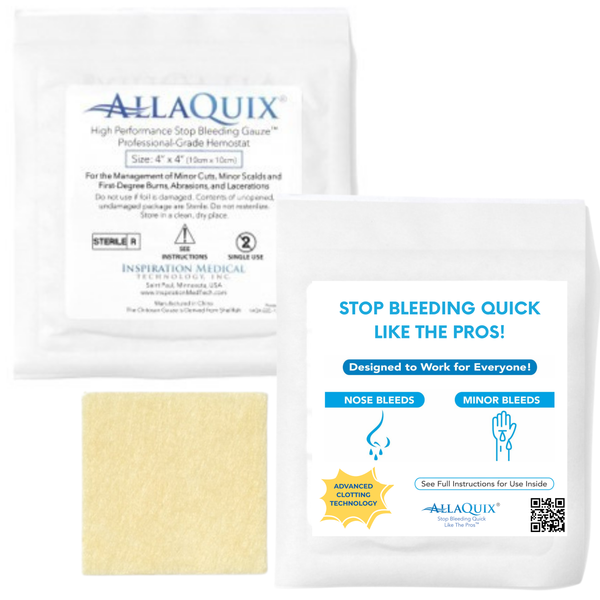
FOR HARDER BLEEDS
AllaQuix® High-Performance
Chitosan gauze. Works by attracting red blood cells to form a seal, so it does not depend on your body clotting normally. The same technology used by the U.S. Military. Available in 2×2, 4×4, and 6×6.
Best for: Deeper kitchen cuts, blood thinners, bleeding disorders
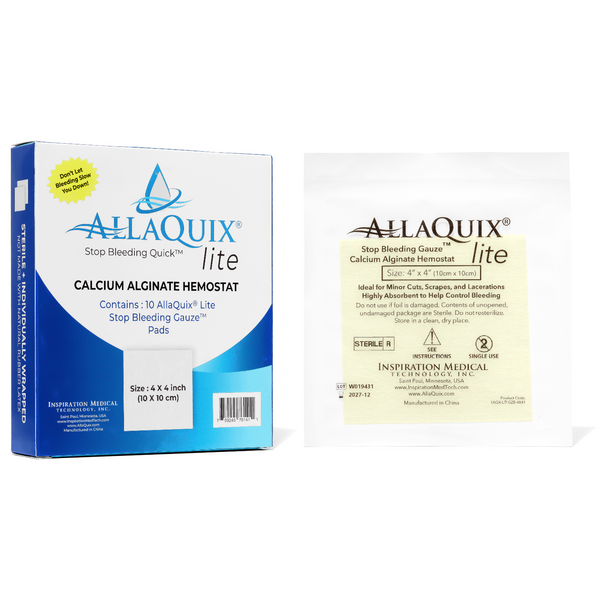
FOR MODERATE BLEEDS
AllaQuix® Lite
Calcium alginate. Absorbs up to 20 times its weight and turns into a protective gel over the wound. Hypoallergenic and gentle on thin or fragile skin. Available in 2×2 and 4×4.
Best for: Moderate cuts, sensitive skin, slower-healing wounds
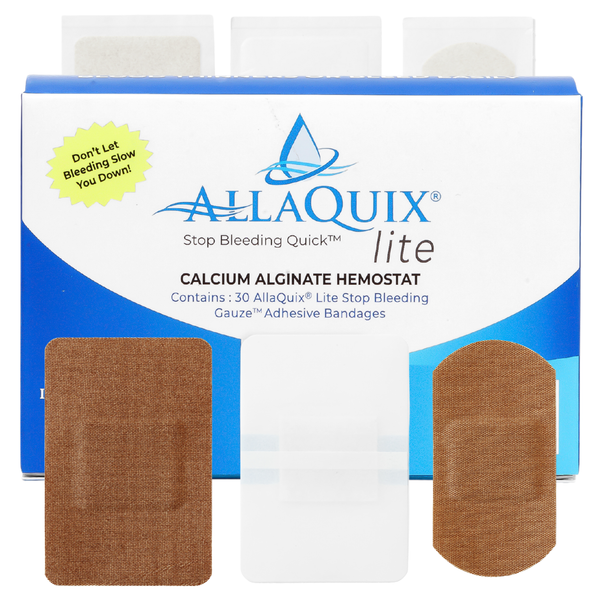
FOR EVERYDAY CUTS
AllaQuix® Bandages
The same calcium alginate in an adhesive bandage. Replaces the box of regular bandages that does not quite handle a real kitchen nick. Available in Variety and Large 2×2.
Best for: Daily cuts, shaving nicks, bleeding gums
Not sure yet? Try it before you need it.
Not for emergency, arterial, or severe bleeding.
Reviewed by Inspiration Medical Technology, Inc. · Updated August 2026
This guide is general first-aid information, not medical advice. It does not replace care from your doctor. Not for emergency, arterial, or severe bleeding. Always read the Instructions for Use before applying any AllaQuix® product.
Made by Inspiration Medical Technology, Inc.
- Dallas, Texas
- FDA reviewed and cleared
- Nearly one million AllaQuix® sold