
How to Stop Bleeding on Blood Thinners
A home guide for people on warfarin, Eliquis, Xarelto, Pradaxa, Plavix or daily aspirin. The blood thinner does not cause the bleed, it lengthens how long it takes to stop. Four steps, what to keep in the drawer, and when to call your doctor.
Reviewed by Inspiration Medical Technology, Inc. General patient education, not medical advice. Always follow the guidance of the clinician who prescribed your medication.
Contents
- The short version
- Why bleeding takes longer on a thinner
- Direct pressure, held the way doctors mean it
- Elevate
- Use the right dressing
- Do not peel
- Warfarin, Eliquis, Plavix and aspirin: does the playbook change?
- When to call your doctor or go to urgent care
- Day-to-day bleeding prevention on a thinner
- What a blood-thinner first-aid drawer should contain
The short version
- Direct pressure, longer than feels normal. 10 to 15 minutes uninterrupted, no peeking, for any meaningful cut. Anything bigger than a small nick deserves a full 15-minute round.
- Elevate the wound above your heart if it's on an arm or leg. Gravity is a free ally.
- Use a hemostatic bandage, not a regular adhesive bandage. A calcium-alginate hemostatic dressing actively pulls fluid out of the bleed and accelerates clotting. Plain gauze just soaks blood and waits.
- Add a second layer if blood soaks through. Don't peel the first one off. Pulling off a partially-formed clot restarts the entire timeline.
- Know the thresholds for when to escalate. The "go to urgent care" line is shorter for you than for someone not on a thinner, covered below.
Everything past this point is the why behind those five steps, plus the specific rules for warfarin vs. the direct-acting oral anticoagulants (DOACs) like Eliquis and Xarelto, and the rules for antiplatelets like aspirin and Plavix.
Why bleeding takes longer on a thinner
Your body normally stops a bleed in two steps. First, the platelets in your blood pile onto the wound and form a soft plug. That's the part antiplatelet medications (aspirin, Plavix, Brilinta) slow down. Second, a cascade of clotting proteins lays down a fibrin mesh on top to harden the plug. That's the part anticoagulants (warfarin, Eliquis, Xarelto, Pradaxa) slow down. Both medication classes leave the wound open longer, which means more bleeding, more bandage changes, and a higher chance that a clot you thought was set actually wasn't.
That is not a complication. That is the medication working exactly as prescribed. Harvard Health and the major hematology centers all make the same point: do not stop your blood thinner without your physician's guidance. The risk of a stroke or a pulmonary embolism is almost always higher than the risk of any household bleed you can manage with pressure and the right dressing.
Direct pressure, held the way doctors mean it
"Hold pressure" is the most common bleeding instruction in medicine and the one most people execute wrong. The fix is simple:
- Use a clean cloth, gauze pad, or hemostatic dressing, anything that can sit flat against the cut.
- Press firmly. Firmly is not gently.
- Hold for a full 10 to 15 minutes by a phone timer. Not "for a while." Not "until it looks better." A clock.
- Do not lift the dressing to check. Every check restarts the clock and tears any partial clot that was forming.
- If blood soaks through, add another pad on top of the first one. Keep pressing.
For most minor bleeds on a thinner, one full round of correct pressure plus a hemostatic dressing will close the wound. The patients who end up frustrated and bandage-changing for hours almost always peeked too early or used a regular adhesive bandage that the wound bled around.
Elevate
If the wound is on an arm, leg, hand, or foot, raise it above the level of your heart while you hold pressure. Gravity reduces the local blood pressure at the wound site and slows the bleed. It is a tiny thing that meaningfully shortens the timeline.
For face, scalp, or torso cuts, skip this step: just hold steady pressure and stay sitting upright.
Use the right dressing
The single most useful change a blood-thinner household can make is swapping the regular bandages and gauze in the medicine cabinet for hemostatic ones.
A hemostatic bandage isn't a marketing word. It means the dressing actively does something to help the clot form: pulling fluid out of the bleed, concentrating clotting factors at the wound surface, or attracting platelets to the dressing fibers. For minor bleeds on a thinner, the most useful format is a calcium alginate dressing. Calcium alginate is a soft, seaweed-derived fiber that absorbs up to 20 times its weight, gels in place, and accelerates clot formation. It's the same material wound clinics use for chronic and slow-to-clot wounds, packaged for home and first-aid use.
Two AllaQuix formats that live well in a blood-thinner first-aid drawer:
- AllaQuix® Lite Calcium Alginate Adhesive Bandages: adhesive bandage format. For the kitchen slice, the shave nick, the bumped-knuckle-on-the-corner-of-the-door bleed. Replaces the regular adhesive bandage in the drawer for any cut that's still oozing after a few minutes of pressure.
- AllaQuix® Lite Hemostatic Gauze (2"x2"): pad format. For wounds that need a separate dressing held in place with pressure or tape, or for larger areas where an adhesive bandage doesn't fit.
Both are sterile, latex-free, drug-free, and intended for minor bleeding. They are not for arterial or emergency bleeding.
THE DRESSING THIS STEP REFERS TO
What to reach for instead of a regular bandage
Calcium alginate gels on contact and gives the wound something to seal against. Chitosan works mechanically, independent of your clotting cascade.
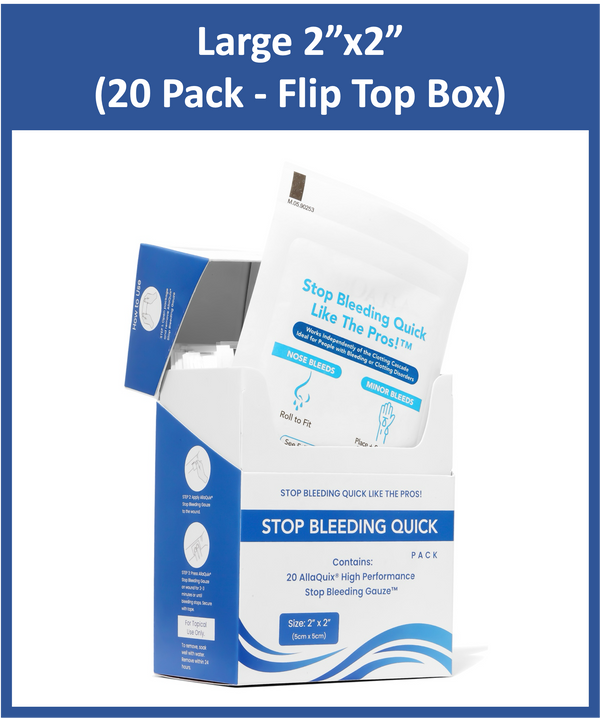
High Performance Gauze 2x2, 20 Pack Flip Top Box

EVERYDAY, LARGER
AllaQuix® Lite Bandages 2"×2"
Calcium alginate adhesive bandages. Absorbs up to 20 times its own weight through a dual mechanism. Hypoallergenic and gentle on fragile skin. Box of 10.
Best for: Kitchen cuts, shaving nicks, skin tears
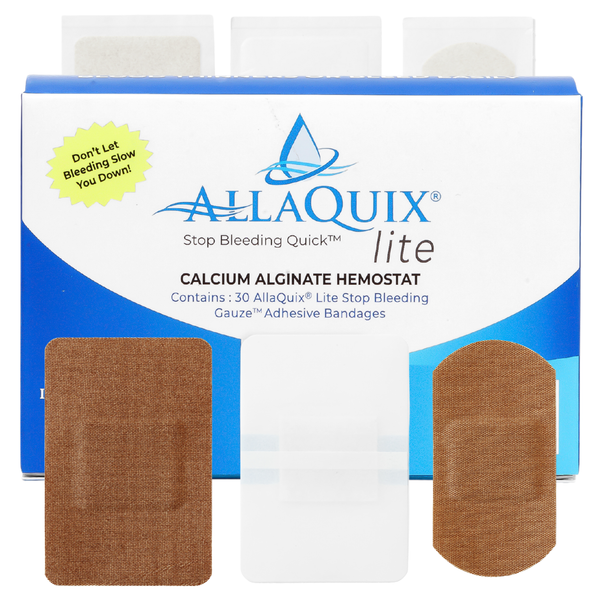
EVERYDAY, ASSORTED
AllaQuix® Lite Bandages, Assorted
The same calcium alginate in assorted smaller sizes, so there is one that fits a knuckle, a fingertip or a forearm. Box of 30.
Best for: The drawer, the handbag, the glovebox
Do not peel
The hardest part of stopping a bleed on a thinner is leaving the first dressing alone. If it soaks through, add a second pad on top of the first and keep pressing. If you peel off the first one to "see what's going on," you peel off the developing clot with it and the wound starts bleeding from the same point again.
Once the bleeding has stopped (give it the full 10 to 15 minutes), leave the original dressing on for several hours, then change it gently using water to lift it off the wound if it's stuck.
Warfarin, Eliquis, Plavix and aspirin: does the playbook change?
The bleeding-control playbook above is identical across thinners. What changes is the timeline expectation:
- Warfarin (Coumadin). Older drug, level checked via INR blood tests. Bleeding time depends heavily on your current INR. The First Aid for Free guide and major hematology references recommend the same pressure-plus-elevation protocol; the difference is that an out-of-range INR can extend the bleed time considerably. If your home INR has been high recently and a cut is bleeding longer than usual, mention both to your physician.
- Eliquis, Xarelto, Pradaxa, Savaysa (DOACs). Newer direct-acting anticoagulants. No INR check needed. Bleeding tends to be more predictable than warfarin but still longer than off-medication. Same pressure protocol; faster escalation to urgent care if a bleed isn't slowing after 20 minutes.
- Aspirin, Plavix, Brilinta, Effient (antiplatelets). Slow the platelet-plug phase. Cuts often look like they've stopped, then start oozing again 5 minutes later. Don't be fooled: hold pressure for the full window, and use a hemostatic dressing rather than a regular bandage.
- Dual therapy (e.g., aspirin + Plavix, or DOAC + aspirin). Expect longer-than-normal bleeding on every minor wound. Tell your physician about any cut that needed more than two rounds of pressure or a trip to urgent care.
When to call your doctor or go to urgent care
The threshold for medical attention is shorter for blood thinner patients than for the general population. The major patient-resource sources (Stop the Clot, Vasculearn, Harvard Health, UH Hospitals) converge on a consistent list:
- Bleeding hasn't stopped after 20 minutes of correct, uninterrupted pressure.
- Cut deep enough that it might need stitches: call before the bleeding gets out of hand, not after.
- Any head injury, even minor, even if there's no visible bleeding. Falls and bumps are the most common cause of avoidable harm in anticoagulant patients.
- Nosebleed lasting more than 10 minutes after correct pinching pressure on the soft part of the nose (see our nosebleed guide for the technique).
- Blood in urine or stool, or unusually heavy menstrual bleeding.
- Coughing or vomiting blood, even a small amount.
- Severe headache, vision change, or sudden weakness: these are stroke-side concerns and trump any bleed.
- A spontaneous bruise larger than the palm of your hand, especially after a minor or no-known-cause impact.
- Heavy bleeding from gums after dental work that lasts more than an hour.
Tell whoever is treating you that you're on a blood thinner before they ask. Name the medication and the dose if you know them. If you have a wallet card or a medical-alert bracelet, that's the moment it pays off.
Day-to-day bleeding prevention on a thinner
Most blood-thinner bleeds at home are preventable. The University Hospitals patient guide and Stop the Clot's "Living Your Best Life" resource list the same handful of changes that reduce the rate dramatically:
- Electric razor instead of a blade. Two minutes of inconvenience, zero shave nicks.
- Soft-bristle toothbrush. Floss gently. Most blood-thinner gum bleeding starts here.
- Cut-resistant gloves in the kitchen for prep work, especially with a sharp knife.
- Sturdy shoes indoors. Closed-toe, non-slip. Most reported bleeds are from stubbed toes, dropped objects, or stepping on something.
- A handrail on every staircase you use regularly. Fall prevention matters more than bleed control.
- Avoid contact sports and any activity with a fall risk you haven't reviewed with your physician.
- Keep a small, organized first-aid kit somewhere you remember it: bathroom, kitchen, glove compartment.
What a blood-thinner first-aid drawer should contain
- AllaQuix® Lite Calcium Alginate Adhesive Bandages: replace your regular bandages.
- AllaQuix® Lite Hemostatic Gauze (2"x2"): pad format for larger or pressure-held wounds.
- AllaQuix® Nose Bleed Gauze: calcium-alginate nose plugs for the nosebleed that takes longer than it used to.
- Roll of self-adherent foam wrap or cohesive bandage, to hold a pad in place without tape pulling skin.
- A small bottle of saline or sterile water for gentle wound rinsing.
- A list of your current medications and your physician's after-hours number, on a card in the kit.
That set covers the great majority of minor bleeds without needing to leave the house.
READY WHEN YOU ARE
Keep them in the drawer
People on thinners rarely get caught out by a dramatic injury. They get caught out by an ordinary cut and nothing in the cupboard that handles it.
High Performance Gauze 2x2, 20 Pack Flip Top Box
EVERYDAY, LARGER
AllaQuix® Lite Bandages 2"×2"
Calcium alginate adhesive bandages. Absorbs up to 20 times its own weight through a dual mechanism. Hypoallergenic and gentle on fragile skin. Box of 10.
Best for: Kitchen cuts, shaving nicks, skin tears
EVERYDAY, ASSORTED
AllaQuix® Lite Bandages, Assorted
The same calcium alginate in assorted smaller sizes, so there is one that fits a knuckle, a fingertip or a forearm. Box of 30.
Best for: The drawer, the handbag, the glovebox
FAQ
Frequently asked questions
Will a hemostatic bandage work if I'm on warfarin?
Yes. Calcium alginate dressings like the AllaQuix® Lite line work by drawing fluid out of the bleed and accelerating local clotting. That mechanism works alongside your medication, not against it. They are widely used in hospital settings for patients on anticoagulants for the same reason.
Can I use a hemostatic dressing for a deep cut that probably needs stitches?
You can hold pressure with a hemostatic pad on the way to urgent care, but you should not try to manage a wound that needs stitches at home. Cover, hold pressure, and get evaluated.
I cut myself shaving and it's been bleeding for 30 minutes. Should I call my doctor?
First: sit, hold direct pressure with a clean pad for 15 minutes uninterrupted, no peeking. If after that full round the bleeding hasn't stopped, yes, call. Don't keep peeling off bandages to check.
Is aspirin really a blood thinner?
Functionally, yes. It's an antiplatelet, which slows the first step of clot formation. Treat it like a thinner for bleeding-control purposes.
My bruises are huge. Is that a problem?
Most blood thinner patients bruise more easily than average. A bruise that's larger than your palm, that you didn't expect, or that keeps growing: flag it with your physician. Same for any swelling that feels firm or painful.
Are AllaQuix® bandages safe for elderly skin?
Yes. The Lite and Derm adhesive lines are designed for sensitive and fragile skin: latex-free, hypoallergenic, and gentle to remove. They are widely used in dermatology offices and by patients whose skin has thinned with age or long-term steroid use.
The bottom line. Blood thinners don't make minor bleeds dangerous. They make them inconvenient. Direct pressure for the full window, elevate when you can, use a calcium alginate dressing instead of a regular bandage, and don't peel the first one off. Keep a small kit where you'll find it. Call your doctor at the 20-minute mark, not the 60-minute mark.
Shop AllaQuix® Lite Adhesive Bandages →
This article is informational and not a substitute for medical advice. AllaQuix® Lite is a sterile, drug-free calcium alginate dressing intended for minor bleeding. Not for emergency, arterial, or severe bleeding. Do not stop taking a prescribed anticoagulant without your physician's guidance.
STOCK THE DRAWER
Try AllaQuix® before you need it
The $10 Variety Pack is a low-cost way to find out which AllaQuix® suits you, rather than finding out while a cut is already going.
Not for emergency, arterial, or severe bleeding. Patient education, not medical advice.
Inspiration Medical Technology, Inc.
Dallas, Texas. Trusted by dermatologists, athletic trainers, hemophilia treatment centers, and the U.S. Military. Nearly one million AllaQuix® sold.