
How to Stop a Nosebleed Fast: A Step-by-Step Guide
Sit up, lean forward, pinch the soft part of your nose for a full 10 to 15 minutes without releasing. If that doesn't work, a calcium alginate nasal plug gives the wound something to seal against. A simple guide for adults, kids, and people on blood thinners.
Reviewed by Inspiration Medical Technology, Inc. All articles are reviewed for accuracy and brand-voice compliance by the team behind AllaQuix®. Not a substitute for medical advice from your doctor.
The four-step routine that works
Most nosebleeds start from a small exposed blood vessel on the front part of the nasal septum called Kiesselbach's plexus. The vessel is exposed enough that dry air, allergies, decongestant sprays, or even a hard nose blow can break it open. The good news is that the vessel is also accessible to direct pressure, which is why pinching the soft part of the nose works so reliably.
The steps below are the standard routine recommended by Mayo Clinic, Cleveland Clinic, and most ENT specialists. Follow them in order and finish each step before moving to the next.
The four steps
- Sit up straight and lean slightly forward
- Pinch the soft part of the nose just below the bridge
- Hold pressure for a full 10 to 15 minutes without releasing
- Avoid hot drinks, heavy lifting, and nose-blowing for 12 hours
Why leaning forward, not back, matters
The instinct when your nose starts bleeding is to tilt your head back, which feels like it should keep the blood from coming out. It doesn't. Tilting back lets blood run down the back of your throat, which causes nausea, can lead to vomiting blood, and can obscure how much you've actually lost.
Leaning slightly forward keeps the blood coming out the front of your nose where you can see it and where it isn't going into your stomach or airway. Sit upright in a chair, lean forward at the waist, and breathe through your mouth.
How long to pinch (longer than you think)
Most people who fail at stopping a nosebleed quickly do so because they let go too early to check. The minimum time for steady, firm pressure is 10 minutes. For someone on a blood thinner, allow a full 15 minutes. Set a timer.
Pinch the soft cartilage of the nose, just below the hard bridge, between your thumb and index finger. Apply enough pressure that you feel the soft tissue compressed firmly against the underlying nasal septum. Breathe through your mouth. Resist the urge to peek.
When to use a nasal plug
If pressure alone doesn't stop the bleeding after a full 15 minutes, or if the nosebleed restarts within a few minutes of stopping, a calcium alginate nasal plug gives the bleeding vessel something to clot against and helps the spot seal.
AllaQuix® Nose Bleed plugs are made from the same calcium alginate as AllaQuix® Lite calcium alginate gauze. The plug is sized for the nostril and individually sealed in a sterile pouch. Insert it gently into the bleeding nostril, hold light pressure for 5 minutes, and leave it in place for at least an hour before removing.
AllaQuix® Nose Bleed Plugs
- Calcium alginate, same material as AllaQuix® Lite
- Sized for nasal use, safe for adults and kids
- Individually sealed for sterile, single-use insertion
- Box of 12 (household) or Box of 100 (clinics, families)
WHAT TO KEEP ON HAND
The plug this step refers to
If pressure alone is slow to work, a calcium alginate plug gives the vessel something to seal against. Keep a box before you need it.
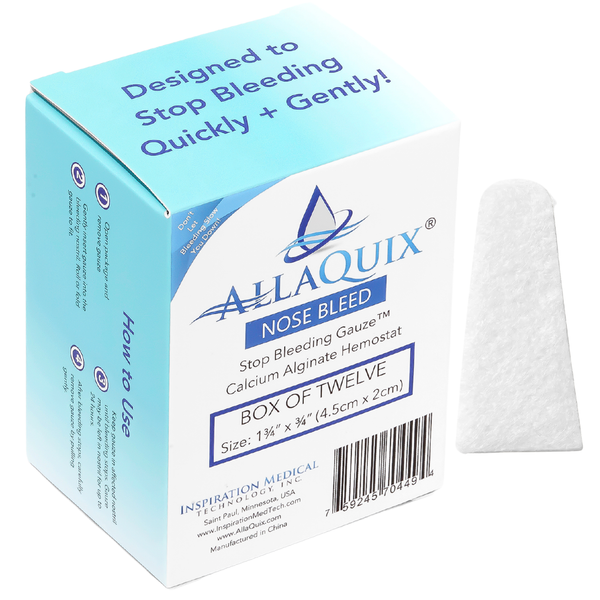
FOR NOSEBLEEDS
AllaQuix® Nose Bleed Plugs (Box of 12)
Calcium alginate plugs sized for nasal anatomy, each sealed in its own pouch. Gives the vessel something to seal against when pressure alone is slow to work.
Best for: Frequent or recurring nosebleeds
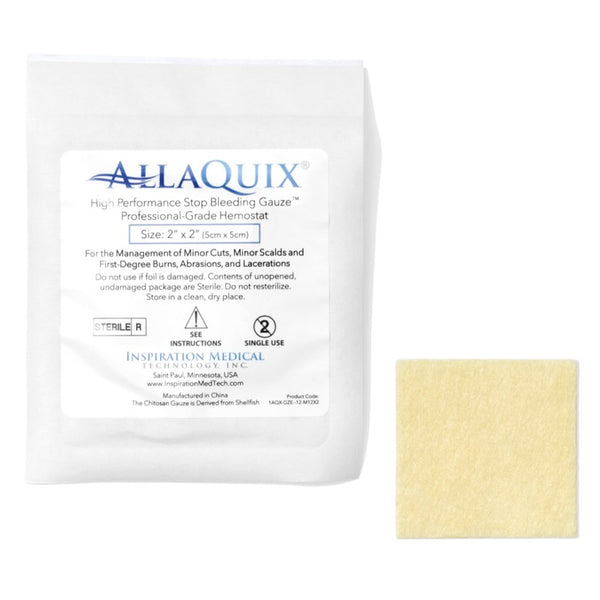
FOR HARDER BLEEDS
AllaQuix® High-Performance 2 × 2
Chitosan hemostatic gauze. Works by attracting red blood cells to form a seal, so it does not depend on your body clotting normally. The same technology used by the U.S. Military.
Best for: Deeper cuts, blood thinners, bleeding disorders
Nosebleeds on blood thinners
Nosebleeds are one of the most common nuisance bleeds people on warfarin, apixaban (Eliquis), rivaroxaban (Xarelto), dabigatran (Pradaxa), and daily aspirin deal with. The blood thinner doesn't cause the bleed, but it lengthens the time it takes to stop.
On a blood thinner, plan on 15 minutes of pressure rather than 10, and consider using a nasal plug earlier in the routine rather than waiting through several pressure cycles. People who normally have trouble stopping bleeding are exactly who AllaQuix® is designed for.
Nosebleeds in kids
Kids get nosebleeds for the same reasons adults do: dry air, allergies, nose picking, and bumps to the face. The technique is the same. Sit upright, lean forward, pinch the soft part, hold for 10 minutes. Make a game of the timer so they don't release early.
AllaQuix® Nose Bleed plugs are safe for kids, but insertion requires an adult. For young children with frequent or stubborn nosebleeds, talk to your pediatrician about evaluation for an exposed septal vessel that may be a candidate for cauterization.
When to call your doctor
Most nosebleeds stop with the routine above. Call your doctor or seek same-day care if a nosebleed lasts more than 20 minutes of continuous pressure, recurs more than three times in a week, follows a head injury, or is accompanied by lightheadedness, weakness, or shortness of breath.
For recurring nosebleeds that won't stop with pressure, an ENT can evaluate for cauterization of the exposed vessel, which is a quick in-office procedure that often eliminates the bleeding for good.
Call your doctor right away if
- Bleeding lasts more than 20 minutes of continuous pressure
- More than 3 nosebleeds in one week
- After a head injury or fall
- Accompanied by lightheadedness, weakness, or fainting
- Blood you can taste running down the back of your throat
READY WHEN YOU ARE
Keep them in the drawer
FOR NOSEBLEEDS
AllaQuix® Nose Bleed Plugs (Box of 12)
Calcium alginate plugs sized for nasal anatomy, each sealed in its own pouch. Gives the vessel something to seal against when pressure alone is slow to work.
Best for: Frequent or recurring nosebleeds
FOR HARDER BLEEDS
AllaQuix® High-Performance 2 × 2
Chitosan hemostatic gauze. Works by attracting red blood cells to form a seal, so it does not depend on your body clotting normally. The same technology used by the U.S. Military.
Best for: Deeper cuts, blood thinners, bleeding disorders
FAQ
Common questions on this topic
Should I lean back or forward during a nosebleed?
Lean forward, not back. Tilting your head back lets blood run down the back of your throat, which can cause nausea, vomiting blood, and can make it hard to tell how much you've actually lost. Sit upright, lean slightly forward at the waist, breathe through your mouth, and pinch the soft part of the nose for a full 10 to 15 minutes without releasing. If pressure alone doesn't stop the bleeding, insert an AllaQuix® Nose Bleed calcium alginate plug into the bleeding nostril.
How long should I pinch my nose for a nosebleed?
Pinch the soft part of the nose continuously for a full 10 minutes — and a full 15 minutes if you're on a blood thinner. Set a timer and resist the urge to release early to check, which is the most common reason a nosebleed seems not to stop.
Why do I keep getting nosebleeds?
Most recurring nosebleeds come from the same exposed blood vessel near the front of the nasal septum (Kiesselbach's plexus). Dry air, allergies, decongestant sprays, blood thinners, and nose blowing can re-open that same vessel. If you get more than one a month, or one won't stop after 20 minutes of pressure, ask your doctor about cauterization.
Are AllaQuix® Nose Bleed plugs safe for kids?
Yes. The plugs are made from calcium alginate, a plant-based material, and are designed for nasal use in adults and children. For young children, an adult should insert the plug and supervise. For minor nuisance nosebleeds only.
Can I use a nasal plug if I'm on a blood thinner?
Yes. Calcium alginate nasal plugs are well suited to people on blood thinners, because they give the bleeding vessel something to clot against. On a blood thinner, consider using a plug earlier in the routine rather than waiting through several pressure cycles.
When is a nosebleed an emergency?
Seek urgent care if a nosebleed won't stop after 20 minutes of continuous pressure, is very heavy, follows a head injury, or comes with lightheadedness, weakness, or fainting. Not for emergency, arterial, or severe bleeding.
Be prepared for bleeding
Not for emergency, arterial, or severe bleeding. Patient education, not medical advice.
Saint Paul, Minnesota · Made in USA
FDA reviewed and cleared. Nearly one million AllaQuix® sold.