
How to Care for a Surgical Incision at Home
Clean, dry and covered. How to change the dressing, when you can shower, and the signs that mean call your surgeon.
Reviewed by Inspiration Medical Technology, Inc. All articles are reviewed for accuracy and brand-voice compliance by the team behind AllaQuix®. Not a substitute for medical advice from your doctor.
The first 48 hours
Most surgical teams ask you to leave the first dressing in place for 24 to 48 hours unless it gets wet, loose or soaked through. That first layer protects the incision while the edges seal.
During this window, keep the dressing dry, keep your hands off it, and rest the area the way your discharge sheet describes. A little pink or clear fluid on the pad in the first day or two is common.
What's normal in the first days
- Mild tenderness and a little swelling along the incision
- A small amount of pink or clear fluid on the pad
- A thin pink line along the edges
- Mild itching as the skin starts to heal
How to change a surgical dressing
When your surgeon says it's time to change the dressing, set everything out first so you're not searching with the incision uncovered.
The routine
- Wash your hands well with soap and water.
- Loosen the old dressing by peeling the border toward the incision, not away from it. If it sticks, dampen it with clean water.
- Look at the incision. Note the color, any fluid, and whether the edges are closed.
- Clean only if you've been told to, usually with mild soap and water. Pat dry. Skip hydrogen peroxide and alcohol.
- Apply a fresh sterile dressing so the pad covers the whole incision and the border sits on dry, healthy skin.
- Wash your hands again.
SMALLER INCISIONS
Sterile island dressings for small incisions
A soft non-adherent pad inside a 1 inch adhesive border. No tape needed.
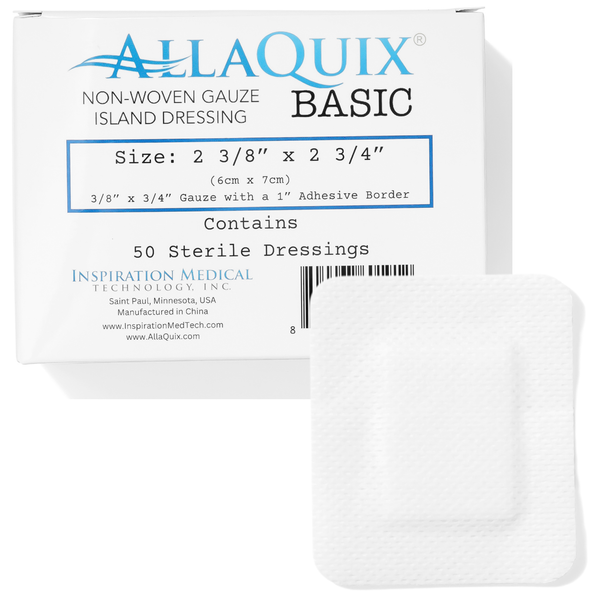
SMALL ISLAND DRESSING
AllaQuix® Basic Small Island Dressing
A soft non-adherent pad inside a 1 inch adhesive border, sized for small incisions, fingers and IV catheter sites. Sterile and latex-free. Box of 50 or a case of 20 boxes.
Best for: small incisions, IV sites, fingers
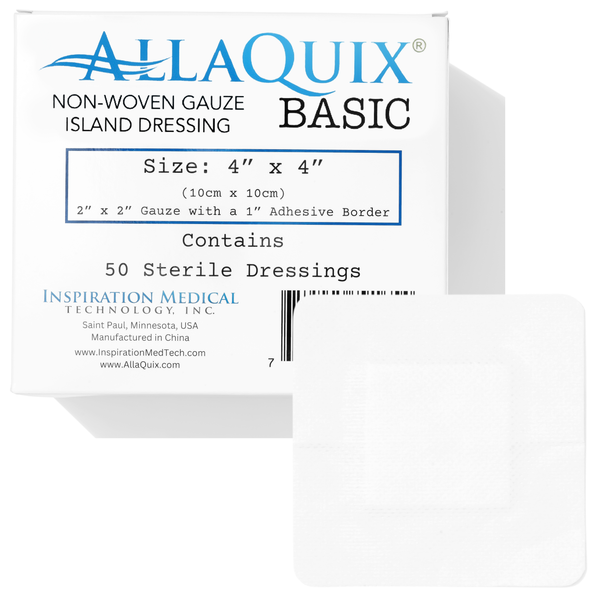
ISLAND DRESSING · 4×4
AllaQuix® Basic Island Dressing 4 × 4
A 2×2 inch non-adherent pad inside a 1 inch adhesive border. Sterile, latex-free and breathable. Box of 50 or a case of 12 boxes.
Best for: incision sites, everyday cuts, light to moderate drainage
Choosing the right dressing size
The rule is simple: the absorbent pad should cover the entire incision, and the adhesive border should sit on healthy skin all the way around. If the border lands on the incision, choose the next size up.
An island dressing (sometimes called a bordered gauze dressing) does both jobs in one piece: a soft pad over the incision and a built-in border, so there's no separate tape. AllaQuix® Basic island dressings use a non-adherent pad that won't stick to the incision, and the Basic line is designed to protect the wound to allow faster healing.
For long incisions after abdominal, back or joint surgery, a longer dressing covers the whole line in one piece, so you are not overlapping small bandages. See every size on the island dressing collection.
Quick size guide
- Small incisions, biopsy sites, IV sites: Basic small island dressing (2⅜ × 2¾)
- Incisions up to about 2 inches: Basic 4 × 4
- Incisions up to about 4 inches: Basic 4 × 6
- Long incisions up to about 12 inches: Basic 4 × 14
LONGER INCISIONS
Island dressings for longer incisions
Cover the whole incision in one piece. Box or case.
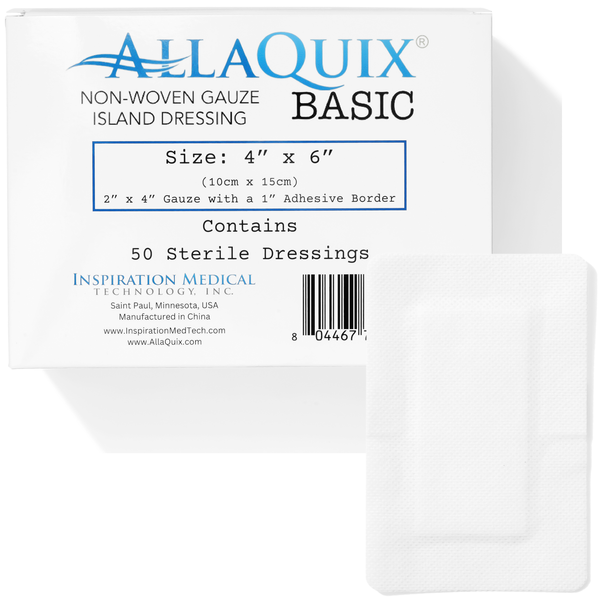
ISLAND DRESSING · 4×6
AllaQuix® Basic Island Dressing 4 × 6
A 2×4 inch pad inside a 1 inch adhesive border, for longer incisions and larger areas. Box of 50 or a case of 12 boxes.
Best for: longer incisions, larger cuts
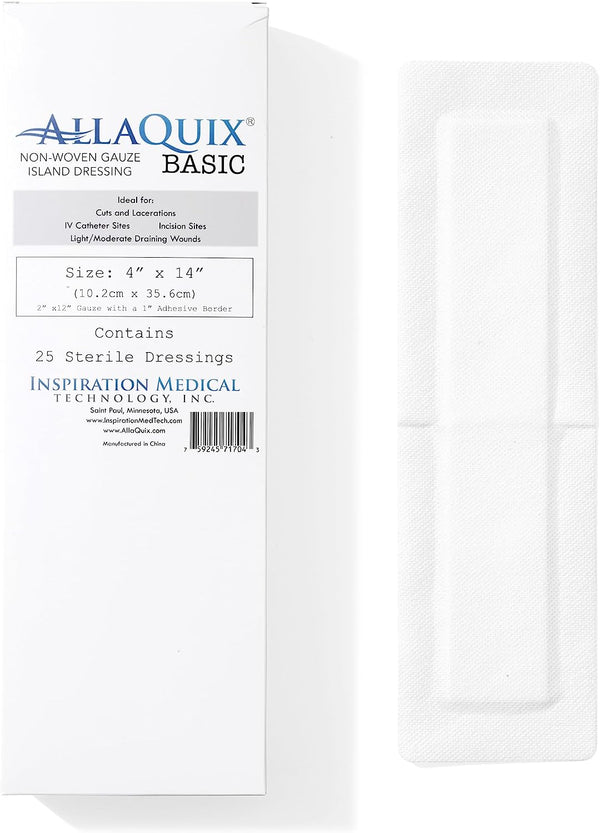
ISLAND DRESSING · 4×14
AllaQuix® Basic Island Dressing 4 × 14
A 2×12 inch pad that covers a long incision in one piece. Box of 25 or a case of 10 boxes.
Best for: long incisions, abdominal and back sites
Showering with an incision
Many surgeons allow a shower after 24 to 48 hours. Ask before your first one, because it depends on the procedure and how the incision was closed.
When you do shower, let clean water run over the area rather than spraying it directly, don't scrub, and pat dry with a clean towel. Put on a fresh dry dressing afterward if you still need one. Baths, hot tubs and swimming usually wait until your surgeon clears you, often after the incision has fully closed.
Stitches, staples, strips and skin glue
How the incision was closed changes the care a little.
By closure type
- Stitches or staples: keep them clean and dry, and don't trim or pull them. Your team will tell you when they come out.
- Adhesive strips: leave them on. They usually loosen and fall off on their own in 7 to 14 days. Don't peel them early.
- Skin glue: don't pick at it or put ointment on it. It flakes off by itself, usually within 5 to 10 days.
- Dissolvable stitches under the skin: nothing to remove. Just keep the surface clean and covered as directed.
Signs of infection and when to call your surgeon
Check the incision each time you change the dressing. Most problems show up between day 3 and day 10, and they're easier to treat when they're caught early.
Call your surgical team if you notice
- A fever of 100.4°F (38°C) or higher
- Redness that spreads outward from the incision, or red streaks
- Warmth, swelling or pain that gets worse instead of better
- Cloudy, yellow or green drainage, or a bad smell
- Edges that pull apart or an incision that opens
- Bleeding that soaks through the dressing. Press firmly over the dressing and call.
For trouble breathing, chest pain, or bleeding you can't control with pressure, call 911.
What to keep at home for recovery
Having supplies ready before you're home makes the first week easier. A simple kit covers most recoveries.
Recovery checklist
- Sterile island dressings sized to your incision, enough for a daily change plus spares
- Mild, fragrance-free soap
- Clean towels set aside for the incision
- A thermometer
- Your discharge instructions and your surgeon's phone number where you can see them
FAQ
Common questions on this topic
When can I remove the bandage after surgery?
Most surgical teams ask you to keep the first dressing on for 24 to 48 hours, then change it daily or when it gets wet or dirty. Some incisions stay covered until the stitches come out. Follow the timing on your discharge instructions.
Should I keep my incision covered or let it air out?
Keep it covered while it's draining, while it could rub on clothing, or whenever your surgeon has asked you to. Many incisions can be left open once they're dry and fully closed. Ask your team which applies to you.
Can I put ointment on a surgical incision?
Only if your surgeon told you to. Many teams ask patients not to use ointment on closed incisions, and ointment can loosen skin glue.
How often should I change a surgical dressing?
Usually once a day, and any time the dressing gets wet, dirty or loose, unless your surgeon gave you a different schedule.
What's the difference between an island dressing and gauze and tape?
An island dressing is a pad and an adhesive border in one piece, so there's no separate tape and the pad stays centered over the incision. Gauze and tape can work too, but the tape often ends up closer to the incision than you'd like.
BEFORE YOU COME HOME
Stock your recovery dressings before surgery day
General patient education, not medical advice. Always follow your surgeon's instructions. Not for emergency, arterial, or severe bleeding.
Dallas, Texas
FDA reviewed and cleared. Nearly one million AllaQuix® sold.