
Bandages for Stitches and Surgical Incisions
AllaQuix® Basic island dressings cover stitches, staples and incisions with a soft non-adherent pad inside a built-in adhesive border, so there's no tape on the incision. Sterile, latex-free and individually wrapped, in four sizes.

Non-adherent pad
A soft absorbent pad that won't stick to the wound, with pain free removal.
Sterile, latex-free
Every dressing individually wrapped. Suitable for sensitive skin.
FDA reviewed and cleared
Professional medical-grade. No prescription required.
Box or case
Order a box for one recovery or a case for a clinic or facility.
What kind of bandage goes over stitches?
Stitches need a covering, not a closure. The stitches, staples or skin glue hold the incision together. The bandage's job is to keep the line clean, absorb light drainage, and come off without pulling on the sutures. That's why most surgical teams send patients home with a bordered island dressing instead of a regular strip bandage.
An island dressing is a sterile absorbent pad (the island) inside an adhesive border. The pad sits over the stitches and the border sticks only to the healthy skin around them. AllaQuix® Basic uses a non-adherent pad that won't stick to the incision, and the Basic line is designed to protect the wound to allow faster healing.
Looking to close a cut rather than cover one? Butterfly strips and closure strips pull wound edges together. A cut that gapes open or may need stitches should be seen by a clinician.
AllaQuix® Basic is ideal for
- Incision sites after surgery or a procedure
- Covering stitches and staples
- IV catheter sites
- Light to moderate draining wounds
- Cuts and lacerations
- Covering and securing devices and other dressings
SHOP BY SIZE
Island dressings for stitches, every size
Pick the size whose pad covers the whole stitch line. Box of 50 (25 for the 4 × 14) or a case.
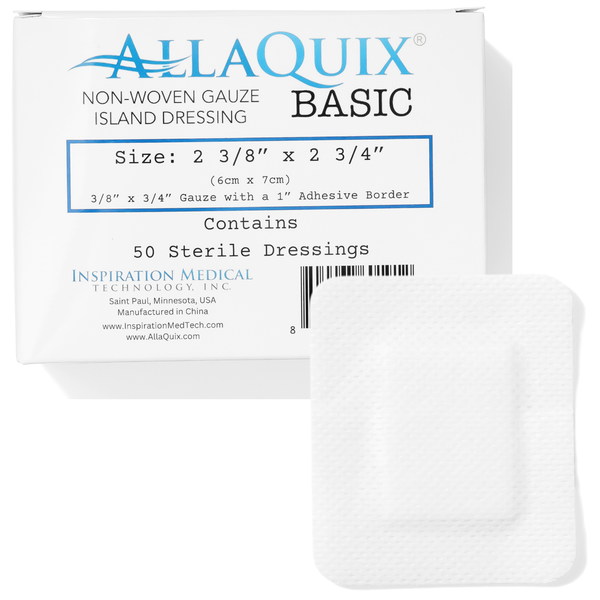
SMALL ISLAND DRESSING
AllaQuix® Basic Small Island Dressing
A soft non-adherent pad inside a 1 inch adhesive border, sized for small incisions, fingers and IV catheter sites. Sterile and latex-free. Box of 50 or a case of 20 boxes.
Best for: small incisions, IV sites, fingers
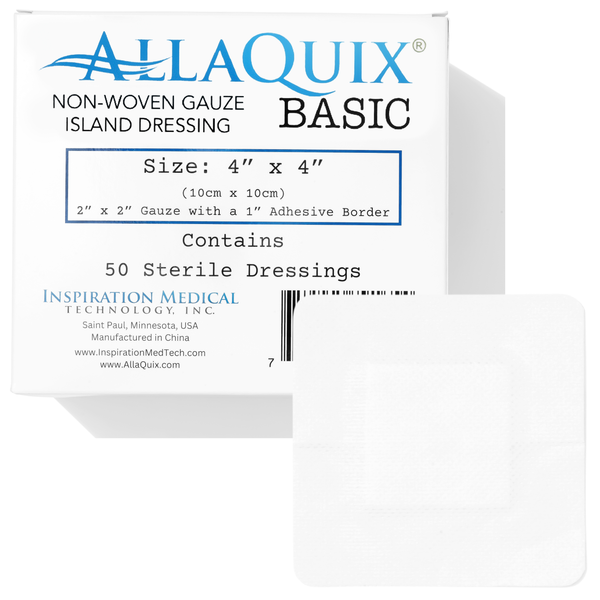
ISLAND DRESSING · 4×4
AllaQuix® Basic Island Dressing 4 × 4
A 2×2 inch non-adherent pad inside a 1 inch adhesive border. Sterile, latex-free and breathable. Box of 50 or a case of 12 boxes.
Best for: incision sites, everyday cuts, light to moderate drainage
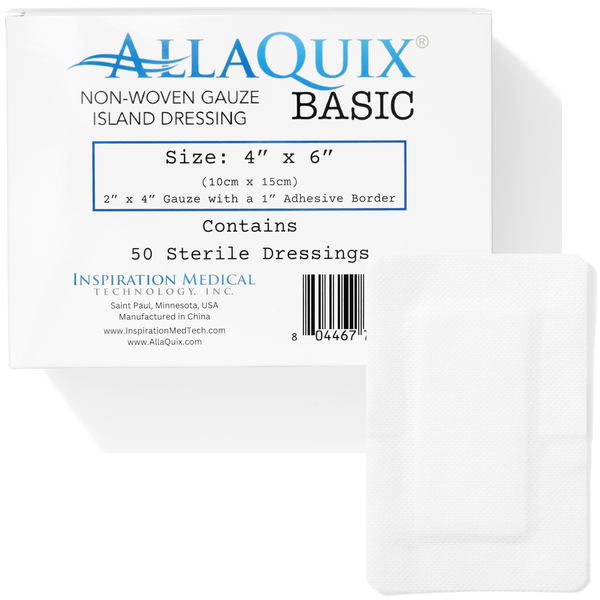
ISLAND DRESSING · 4×6
AllaQuix® Basic Island Dressing 4 × 6
A 2×4 inch pad inside a 1 inch adhesive border, for longer incisions and larger areas. Box of 50 or a case of 12 boxes.
Best for: longer incisions, larger cuts
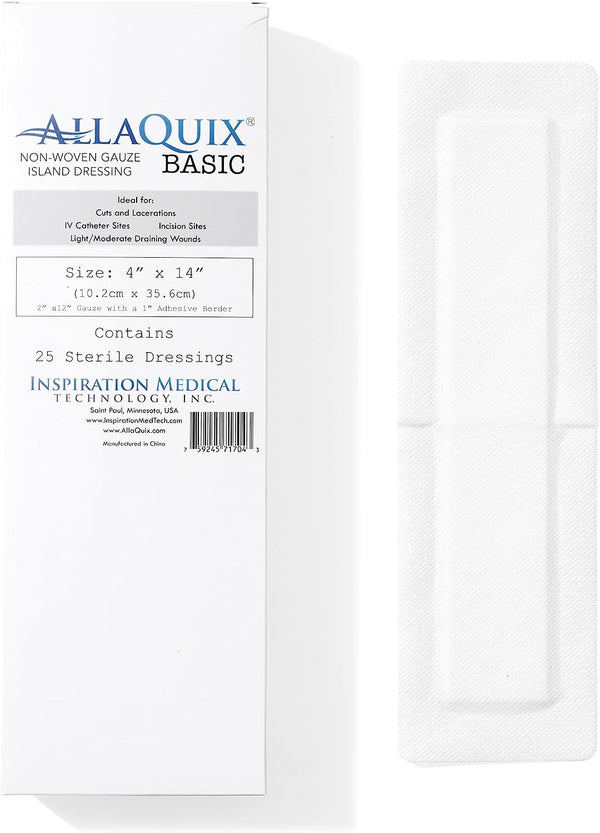
ISLAND DRESSING · 4×14
AllaQuix® Basic Island Dressing 4 × 14
A 2×12 inch pad that covers a long incision in one piece. Box of 25 or a case of 10 boxes.
Best for: long incisions, abdominal and back sites
SIZE GUIDE
Match the pad to the length of the stitch line
2⅜ × 2¾ small
A ⅜ × ¾ inch pad. For IV catheter sites, laparoscopic port sites, biopsy sites and small incisions. Box of 50 or case of 1,000.
4 × 4
A 2 × 2 inch pad. The everyday size for incisions up to about 2 inches, cuts and scrapes. Box of 50 or case of 600.
4 × 6
A 2 × 4 inch pad. For incisions up to about 4 inches and larger cuts. Box of 50 or case of 12 boxes.
4 × 14
A 2 × 12 inch pad. Covers a long incision in one piece, such as a knee, hip, abdominal or back incision. Box of 25 or case of 10 boxes.
How to put a bandage over stitches
Set everything out first, so the stitches aren't uncovered while you look for supplies. Your surgeon's instructions come first: some incisions stay covered until the stitches come out, and some can be left open once they're dry.
The routine
- Wash your hands with soap and water.
- Check the size. The pad should cover every stitch, with the border on dry, healthy skin.
- Peel the backing and center the pad over the stitches without touching the pad.
- Smooth the border outward from the center so there are no wrinkles.
- Change it daily, or whenever it gets wet, dirty or loose, unless your surgeon gave you a different schedule.
- To remove it, lift a corner and peel low and slow toward the incision, not away from it.
Call your surgeon for a fever, redness that spreads, pus or a bad smell, or stitches that pull apart.
FAQ
Questions about bandages for stitches
Should stitches be covered?
Usually, yes, for the first days. Most surgical teams ask you to keep stitches covered for at least 24 to 48 hours, and longer if the incision is draining or rubs on clothing. Once the incision is dry and closed, many can be left open. Your surgeon's instructions come first.
What is the best non-stick bandage for stitches?
Look for a sterile dressing with a non-adherent pad and an adhesive border that stays off the stitch line. AllaQuix® Basic island dressings have a soft non-adherent pad with pain free removal, in four sizes from the small 2⅜ × 2¾ to the 4 × 14.
What bandage should I use for stitches on my face or finger?
The AllaQuix® Basic small island dressing (2⅜ × 2¾) is sized for small sites like the face, fingers, biopsy sites and IV sites.
Can I shower with a bandage over my stitches?
AllaQuix® Basic is breathable non-woven material, not waterproof. Ask your surgeon when you can shower. Afterward, pat the area dry and put on a fresh dressing if you still need one.
How long should I keep a bandage on after stitches?
Most people change the dressing once a day until the stitches come out or the incision is fully closed and dry, usually one to two weeks. Follow the schedule on your discharge instructions.
Is an island dressing the same as a butterfly bandage?
No. A butterfly bandage holds the edges of a cut together. An island dressing covers and protects a wound that is already closed with stitches, staples, strips or glue.
BEFORE SURGERY DAY
Have your stitch dressings ready before you come home
A box of 50 covers a daily change for most recoveries, with spares.
General wound care information, not medical advice. Always follow your doctor's instructions. Not for emergency, arterial, or severe bleeding.
KEEP GOING
More for your recovery
Dallas, Texas
FDA reviewed and cleared. Nearly one million AllaQuix® sold.