Hemophilia at Home: A Family Guide to Managing Minor Bleeds Confidently
Updated May 20, 2026 · Written by the AllaQuix® Team · Reviewed for approved claims and accuracy.
Most of what's written about hemophilia online is written for clinicians. This is written for families: the parent of the kid with hemophilia A who just learned, the spouse of the patient whose dosing schedule everyone is still adjusting to, the adult who's been managing this since childhood and is still occasionally surprised. Hemophilia at home is about a small set of habits that, repeated correctly, keep the great majority of minor bleeds from turning into anything worse.
This guide is a practical family resource for managing minor bleeds at home, with the caveat that should be on every hemophilia article: nothing here replaces guidance from your Hemophilia Treatment Center (HTC) or your hematologist. The protocols below are meant to make their advice easier to follow, not to substitute for it.
The home-care framework
Most U.S. HTCs teach the same general framework for managing minor bleeds at home:
- Recognize the bleed early. Bleeds are easier to control when they're caught fast: joint stiffness, an unusual ache, a swelling that wasn't there an hour ago.
- Treat with factor according to your prescribed plan. For most patients on prophylaxis or with on-demand factor, the home-infusion schedule is the foundation. Self-infuse or have a trained family member infuse at the first sign of a bleed.
- For minor cuts and surface bleeds, apply direct pressure and the right dressing. A hemostatic dressing dramatically shortens the timeline.
- For joint and muscle bleeds, follow the PRICE protocol. Protection, Rest, Ice, Compression, Elevation.
- Document the bleed: what triggered it, when factor was given, how it responded. Your HTC uses this data at every visit.
- Call the HTC for anything outside the framework: head bumps, internal bleeds, a joint that's not responding to factor, fever, or anything new.
Building the family first-aid kit
A hemophilia-aware household kit is different from a general first-aid kit. The items that matter most:
- Factor product and infusion supplies: exactly as prescribed by your HTC, with backup supplies for travel.
- Calcium alginate adhesive bandages: replace the regular adhesive bandages. The AllaQuix® Lite Calcium Alginate Adhesive Bandages are widely used in hemophilia clinic settings; they work the same way at home.
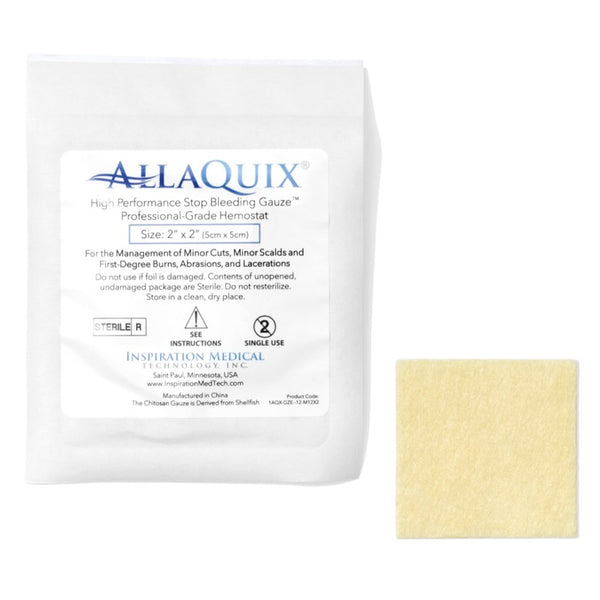
- Calcium alginate pads: for larger surface bleeds. AllaQuix® Lite 2"x2" and 4"x4" pads.
- Hemostatic nose plugs: nosebleeds are common and can be the most demanding minor bleed for hemophilia patients. AllaQuix® Nose Bleed Gauze stops them faster than regular tissue or pressure alone.
- Cohesive wrap / self-stick foam wrap: for compression in PRICE protocol and for holding pads in place without skin-pulling tape.
- Ice packs and a reusable cold gel pack: for joint and muscle bleeds.
- Medical alert bracelet or wallet card: for the patient, with bleeding-disorder type, current factor product, and HTC phone number.
- A bleed log: paper notebook or app, whatever the family will actually use. Track every meaningful bleed.
The HTC-specific sample box at /products/htc-sample-box is built for clinicians evaluating these products for their patient population.
PRICE for joint and muscle bleeds
For a suspected joint or muscle bleed (a "deep" bleed, not a surface cut), the standard protocol after factor infusion is PRICE:
- P: Protection. Protect the affected joint or muscle from further injury. A splint or immobilizer for a knee or elbow; a sling for a shoulder; crutches if walking is making it worse.
- R: Rest. Keep weight and motion off the area. Several days at a minimum, sometimes longer.
- I: Ice. Ice pack wrapped in a thin cloth, 15–20 minutes at a time, with breaks. Reduces inflammation around the bleed.
- C: Compression. A self-stick foam wrap or elastic bandage at moderate tension, firm but not constricting. Limits further swelling.
- E: Elevation. Above the level of the heart when possible. Drains fluid and reduces swelling.
PRICE is in addition to factor, not a replacement for it. If a joint bleed isn't responding to factor and PRICE within a few hours, call the HTC.
Minor cuts and surface bleeds
For a small cut, scrape, or surface laceration, the protocol is direct pressure plus a hemostatic dressing:
- Wash hands if time allows.
- Apply a calcium alginate adhesive bandage or a sterile alginate pad directly on the bleeding surface.
- Hold firm direct pressure for 10–15 minutes, uninterrupted. No peeking.
- If blood soaks through, add a second pad on top of the first. Do not lift the first one off.
- Once the bleed is controlled, leave the dressing in place for several hours. Change gently with water if it sticks.
If the bleeding hasn't slowed after 20 minutes of correct pressure, call your HTC. For a hemophilia patient, that's earlier escalation than the general "20 minutes" threshold most non-hemophilia bleeding guides cite.
Nosebleeds in hemophilia
Nosebleeds are common, often dry-air-driven in winter, and can be among the most stubborn minor bleeds for hemophilia patients. The protocol:
- Sit up, lean forward.
- Pinch the soft part of the nose (not the bony bridge) for 10–15 minutes uninterrupted.
- If still bleeding, insert a calcium alginate nose plug into the bleeding nostril and continue pinching.
- If still bleeding after 20 total minutes with the plug in place, call your HTC.
Dry-air prevention matters. A cool-mist humidifier in the bedroom in winter and a thin smear of plain petroleum jelly inside each nostril at bedtime reduce recurring nosebleed frequency considerably.
The "call the HTC" thresholds
Different HTCs have slightly different escalation rules, but the common ones across U.S. centers:
- Any head bump, even minor, even with no visible bruise. Intracranial bleeds in hemophilia patients can present with no early external signs.
- Any joint bleed not improving within a few hours of factor infusion.
- Any minor bleed that hasn't responded to direct pressure plus a hemostatic dressing within 20 minutes.
- Blood in urine, stool, vomit, or sputum.
- Severe abdominal pain.
- Numbness, weakness, vision change, or severe headache.
- Fever, especially with any signs of infection at an old injection site.
- Anything that just doesn't feel right.
If you cannot reach the HTC and the situation seems urgent: emergency room. Bring the patient's wallet card, factor product if possible, and a recent visit summary.
Living with hemophilia at home: the boring habits that matter most
- Soft-bristle toothbrush, gentle flossing. Most preventable mouth bleeds start here.
- Electric razor for adolescents and adults who shave.
- Helmet for biking and skating, no contact sports without HTC clearance.
- Closed-toe shoes indoors. Most reported home bleeds start with stubbed toes.
- Padded play surfaces for toddlers and young children.
- Avoid NSAIDs (ibuprofen, aspirin, naproxen) unless your hematologist explicitly approves. Acetaminophen is generally the preferred OTC pain reliever for hemophilia patients.
- Travel preparation: copies of HTC contact info, factor product, infusion supplies, and a medical letter for security screenings.
Support and patient resources
Three resources every hemophilia family should know:
- National Bleeding Disorders Foundation (NBDF): patient education, peer support, advocacy, "Steps for Living" online resource.
- Hemophilia Federation of America (HFA): Blood Brotherhood and Blood Sisterhood peer programs for adults living with bleeding disorders.
- The CDC Hemophilia Program: current treatment guidelines and HTC locator.
Your HTC is the closest, most personal resource. The national foundations are the long-term community.
Frequently asked questions
Are AllaQuix® Lite dressings safe for hemophilia patients?
Yes. Calcium alginate works through ion exchange and clot support. It works alongside factor therapy, not against it. Calcium alginate dressings are widely used in hemophilia treatment center settings for this reason.
Should I infuse factor for a small cut?
Follow your HTC's specific guidance. Many patients on prophylaxis won't need extra factor for a minor surface bleed that responds to pressure plus a hemostatic dressing. On-demand patients may need to infuse. When in doubt, call the HTC.
Can I give my child ibuprofen for a sports injury?
Generally no without HTC approval. NSAIDs (ibuprofen, naproxen, aspirin) impair platelet function and can worsen bleeding. Acetaminophen is the standard alternative. Ask your hematologist.
What if we're traveling and a bleed happens?
Travel with factor product and supplies. Carry your HTC's contact info in a wallet card and on your phone. Most HTCs offer 24-hour on-call coverage. If you're abroad, the World Federation of Hemophilia (WFH) maintains a network of international treatment centers.
How often should we be checking in with the HTC?
Most HTCs see patients every 6–12 months for routine visits, more frequently after a new diagnosis or a treatment change. Between visits, call for any of the escalation thresholds above.
Are there support groups for parents of kids with hemophilia?
Yes. NBDF's Steps for Living program has age-specific resources, and HFA's regional chapters host family events and peer connections. Most HTCs can connect newly-diagnosed families with experienced families in the same region.
The bottom line. Hemophilia at home is about a small set of habits done well: knowing the early signs of a bleed, infusing factor on the prescribed schedule, having the right dressings on hand, following PRICE for joint bleeds, and calling the HTC at the thresholds they've set with you. The boring habits prevent most of the dramatic moments.
Request an AllaQuix® HTC Sample Box →
This article is informational and not a substitute for medical advice or your HTC's specific guidance. AllaQuix® Lite is a sterile, drug-free calcium alginate dressing intended for minor bleeding. Not for severe bleeding or for use as a substitute for factor therapy. Always follow your hematologist's and HTC's instructions first.