
How to Stop a Deep Cut from Bleeding at Home
What to do in the first 60 seconds, what to skip, and the specific thresholds for when home care is wrong and you need professional care.
Reviewed by Inspiration Medical Technology, Inc. All articles are reviewed for accuracy and brand-voice compliance by the team behind AllaQuix®. Not a substitute for medical advice from your doctor.
The first 60 seconds
A deep cut is the moment most people freeze. This is the core sequence, and almost every deep cut at home that is not an emergency responds to it within one or two rounds of pressure.
The sequence
- Sit down. Standing increases blood loss and the risk of fainting from a vasovagal response.
- Apply firm, direct pressure with a clean cloth, gauze pad, or hemostatic dressing.
- Elevate the wound above your heart if it is on an arm or leg.
- Hold for 15 minutes uninterrupted. No peeking. No swapping the cloth. A clock helps.
- If blood soaks through, add a second layer on top. Do not lift the first one off.
How to tell what kind of bleed you are dealing with
There are three categories, and the right response is different for each. If you are not sure which you have, treat it as the more urgent one. Pressure works on all three.
Three categories
- Capillary bleeding. Slow, steady ooze of dark red blood. Pressure stops it within a few minutes.
- Venous bleeding. Steady flow of darker red blood. Pressure stops it within 10 to 15 minutes if held correctly.
- Bleeding that pulses. Bright red, spurting in rhythm with your heartbeat. This is the emergency. Apply firm pressure immediately and call 911.
What to use as a dressing
The hierarchy runs from worst to best, and the difference matters more than most people expect.
Worst to best
- Cotton ball or tissue. Worst. Fibers stick to the clot and tear it off when removed. Skip.
- Clean cloth or kitchen towel. Better than nothing. Works for direct pressure.
- Sterile gauze pad. Good. Sized 2 by 2 or 4 by 4 for most home cuts.
- Hemostatic gauze. Best. Works alongside firm pressure rather than replacing it, and gives the wound something to clot against.
WHAT TO PRESS WITH
The dressing that belongs in this moment
A larger chitosan pad for the deep cut itself, and a cohesive wrap to hold it without putting tape on skin.
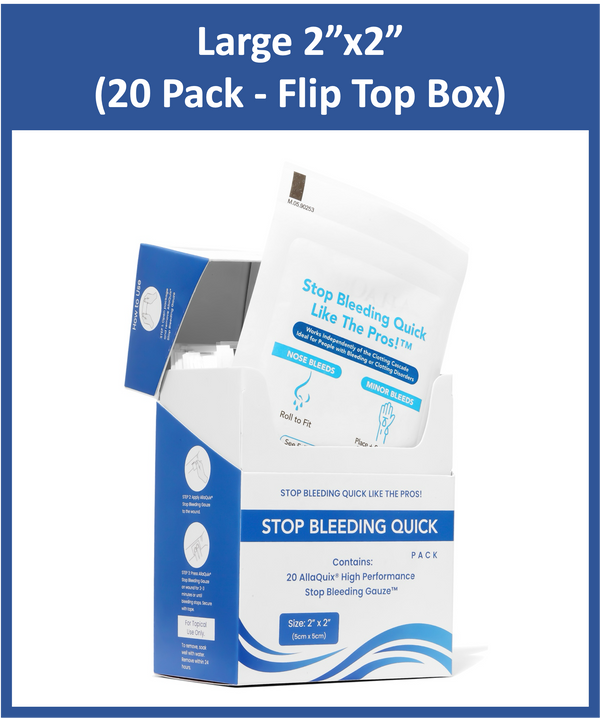
High Performance Gauze 2x2, 20 Pack Flip Top Box
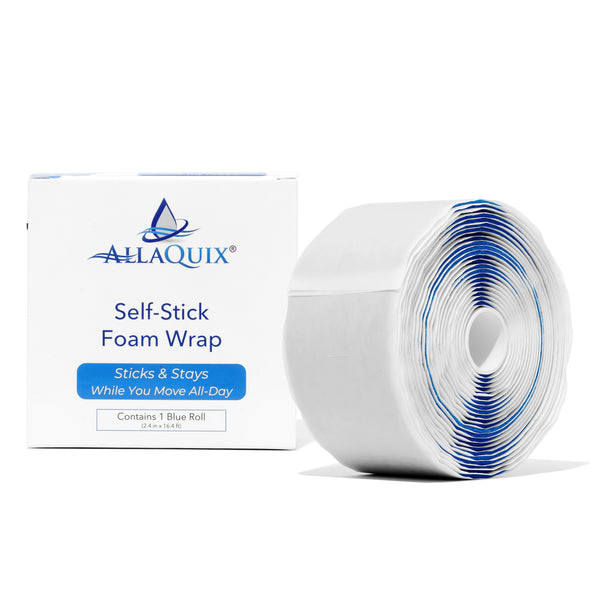
NO TAPE ON SKIN
Wrapid™ Self-Stick Foam Wrap
Grips only itself, never skin or hair. Holds a dressing in place without adhesive anywhere near the wound.
Best for: securing a dressing, moving body parts
To rinse or not to rinse
For an actively bleeding deep cut, the answer is no. Stop the bleeding first. Rinsing during active bleeding washes away the platelets and proteins your body is trying to use to clot, and it sends you back to step one.
Once the bleeding has stopped, gentle rinsing with clean water for a minute or so is appropriate, to remove dirt, glass, or other debris. Skip the hydrogen peroxide and rubbing alcohol, because both damage healthy tissue and slow healing.
When the cut needs stitches
Stitches generally need to happen within 6 to 8 hours of the injury to be most effective and to reduce infection risk. Do not wait overnight to see how it looks in the morning if the wound meets any of these.
Probably needs stitches if
- The cut is deeper than a quarter inch.
- The edges gap when you relax and do not sit naturally together.
- You can see fat, muscle, or anything that is not skin.
- It is longer than about half an inch, or any visible cut on the face.
- It crosses a joint, where motion will keep pulling it open.
- It was caused by something dirty, rusty, or biological.
- Bleeding has not stopped after 15 minutes of correct pressure.
Urgent care or emergency room
For a deep cut without pulsing bleeding, urgent care is almost always the right choice. It is faster, cheaper, and most urgent care centers can do stitches, give a tetanus booster, and prescribe antibiotics if there is infection risk.
Go to the ER instead if
- The bleeding is bright red and pulsing.
- You can see deep structures such as bone, tendon, or muscle.
- The cut is on the face and complex, involving the eye, lip border, or ear.
- You are on a blood thinner and bleeding has not slowed.
- The cause was a saw, glass, or an animal bite to the face.
- You are not up to date on tetanus and the wound is dirty.
Special cases: kids, blood thinners, fragile skin
Kids. The protocol is the same: pressure, elevation, hold. The difference is that kids panic easily, and a parent staying calm is half the work. Distract while you hold, and do not peek to show them.
Blood thinner patients. Bleeding takes longer. Pressure for 15 to 20 minutes, not 10. Use a hemostatic dressing rather than a regular bandage, and call your physician at the 20-minute mark if it is not slowing.
Fragile skin. Thin skin tears easily, and pressure that is too aggressive can cause additional tearing around the wound. Press firmly but not crushingly. Calcium alginate adhesive bandages are designed for sensitive skin and remove cleanly without pulling.
What to do after the bleeding stops
Watch for signs of infection over the next 5 to 7 days: spreading redness, warmth, swelling, pus, fever. If any appear, see a clinician.
The next few days
- Gently rinse with clean water to remove debris. Do not scrub.
- Pat dry around the wound, not on it.
- Apply a thin layer of plain petroleum jelly to keep the surface moist.
- Cover with a non-stick pad and tape, or a calcium alginate adhesive bandage.
- Change the dressing daily, or sooner if it gets wet or soiled.
READY WHEN YOU ARE
Stock it before the moment arrives
Sit, press, elevate, hold for 15 minutes uninterrupted. The dressing only helps if it is already in the drawer.
High Performance Gauze 2x2, 20 Pack Flip Top Box
NO TAPE ON SKIN
Wrapid™ Self-Stick Foam Wrap
Grips only itself, never skin or hair. Holds a dressing in place without adhesive anywhere near the wound.
Best for: securing a dressing, moving body parts
FAQ
Common questions on this topic
Should I use a tourniquet on a deep cut?
Only for bleeding that cannot be controlled from a limb, and only if firm direct pressure cannot stop it. Tourniquets carry their own risks and should be a last resort. For the home deep-cut scenario, direct pressure plus a hemostatic dressing handles the great majority of cases.
Can I use super glue to close a small deep cut?
Medical-grade skin adhesive can close small, clean, straight-edged cuts that do not gap badly. Household super glue is not the same product and is not designed for skin contact, so skip it unless your physician tells you otherwise.
What about butterfly bandages or wound closure strips?
For shallow cuts with edges that sit naturally together, butterfly closures work well. Clean the wound, dry the surrounding skin, and apply the strips perpendicular to the cut. Deeper or gaping wounds usually need professional closure.
How long should I wait before going to urgent care?
Do not wait if the wound meets any of the needs-stitches criteria. Stitches lose effectiveness after 6 to 8 hours. For ambiguous wounds, 15 minutes of correct pressure followed by an honest look is the decision moment.
Why do you keep saying not to peek?
Because the single most common reason a deep cut keeps bleeding at home is lifting the dressing to check, which pulls off the developing clot every time. The clock has to run uninterrupted.
BEFORE YOU NEED IT
Sit, press, elevate, hold
Not for emergency, arterial, or severe bleeding. General patient education, not medical advice.
Dallas, Texas
FDA reviewed and cleared. Nearly one million AllaQuix® sold.