
What is Calcium Alginate? Dual Mechanism Explained.
Calcium alginate is a plant-derived hemostat that stops bleeding through two mechanisms at once: calcium ions accelerate the body's clotting cascade, and the alginate fibers absorb up to 20 times their weight to form a protective gel over the wound.
Reviewed by Inspiration Medical Technology, Inc. All articles are reviewed for accuracy and brand-voice compliance by the team behind AllaQuix®. Not a substitute for medical advice from your doctor.
DUAL MECHANISM
Calcium alginate stops bleeding in four steps
Releases calcium
On contact with wound fluid, the alginate matrix releases calcium ions. Calcium is a known accelerator of the clotting cascade.
Absorbs fluid
The alginate fibers absorb up to 20× their own weight in wound exudate, drawing fluid out of the wound.
Forms gel
As the fibers absorb, they convert into a protective gel that conforms to the wound bed and maintains a moist healing environment.
Lifts off clean
The gel dressing lifts off without sticking to the underlying tissue, so it does not retraumatize the wound on removal.
WHAT TO KEEP ON HAND
The calcium alginate dressing itself
Two sizes carry the calcium alginate: the everyday 2 × 2 and the larger 4 × 4. Both are FDA reviewed and cleared, and neither needs a prescription.

THE CALCIUM ALGINATE LINE
AllaQuix® Lite Gauze 2 × 2
Calcium alginate gauze in the everyday size. Releases calcium to support clotting while absorbing up to 20 times its weight and gelling over the wound. Hypoallergenic and gentle on thin or fragile skin. Box of 20.
Best for: small cuts, sensitive skin, daily nuisance bleeds
LARGER COVERAGE
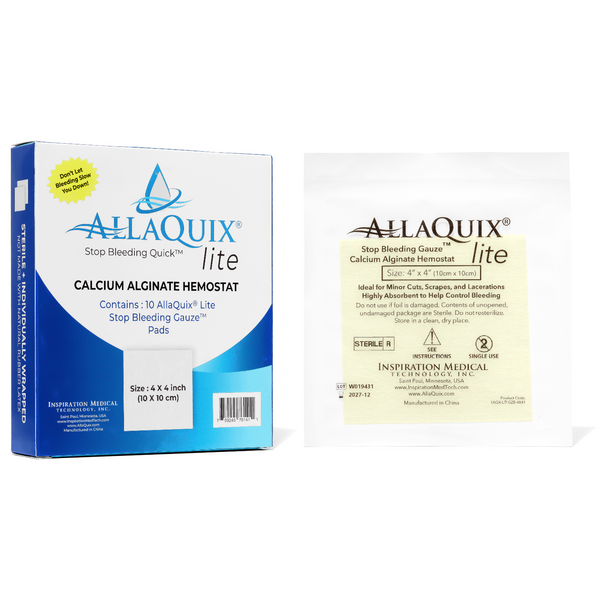
AllaQuix® Lite Gauze 4 × 4
The larger pad, for bigger or more heavily draining wounds. Same calcium alginate, same gentle lift-off, more surface area and more absorbency.
Best for: larger wounds, moderate drainage, post-procedure sites
Where calcium alginate comes from
Alginate is a natural polysaccharide harvested from brown seaweed, primarily kelp (Laminaria species) and Macrocystis. The processing extracts the alginic acid from the seaweed and converts it into sodium alginate. To produce calcium alginate, the sodium alginate is then ion-exchanged with calcium to make the final wound-dressing material.
Calcium alginate has been used in wound care since the 1980s and is one of the most widely studied moist-healing dressings in clinical practice. It is plant-derived, drug-free, and hypoallergenic, which makes it well-suited for patients with sensitive or fragile skin.
Why "dual mechanism" matters
Most hemostatic dressings work through a single mechanism. Chitosan binds red blood cells mechanically. Kaolin activates Factor XII. Traditional gauze just absorbs blood passively. Calcium alginate works through two mechanisms at once, which is why it shows up in clinical wound care across a wider range of use cases than single-mechanism products.
The first mechanism is biochemical: calcium ions released from the dressing accelerate the body's own clotting cascade. The second mechanism is physical: the alginate fibers absorb fluid and form a protective gel that maintains a moist healing environment. Together, the two mechanisms make calcium alginate effective on moderately draining wounds, on sensitive skin, and on the everyday cuts that don't need a chitosan-strength solution.
Where AllaQuix® uses calcium alginate
- AllaQuix® Lite (2×2, 4×4 calcium alginate gauze)
- AllaQuix® Bandages (Variety + Large adhesive bandages)
- AllaQuix® Nose Bleed (nasal plugs)
- AllaQuix® Derm (specialty dermatology gauze and bandages)
Where calcium alginate works best
Calcium alginate is the right choice when the wound is moderately draining (the absorption mechanism shines), when the patient has sensitive or fragile skin (the gentle lift-off matters), or when the wound is on a sensitive site like the face or a finger (the conformability of the gel helps).
It's used heavily in dermatology, post-surgical wound care, pressure injury management, leg ulcer treatment, and at-home care for elderly patients. AllaQuix® Lite is the consumer OTC version of the same calcium alginate material used in clinical settings.
Related: what is chitosan? · shop Lite · everyday cuts & scrapes
READY WHEN YOU ARE
Add it to the drawer
THE CALCIUM ALGINATE LINE
AllaQuix® Lite Gauze 2 × 2
Calcium alginate gauze in the everyday size. Releases calcium to support clotting while absorbing up to 20 times its weight and gelling over the wound. Hypoallergenic and gentle on thin or fragile skin. Box of 20.
Best for: small cuts, sensitive skin, daily nuisance bleeds

GRAB-AND-GO
AllaQuix® Lite Adhesive Bandages
The same calcium alginate on an adhesive bandage, for the cuts you treat one-handed at the kitchen sink. No wrapping or taping needed.
Best for: fingers, knuckles, everyday household cuts
FAQ
Common questions on this topic
What is calcium alginate and how does it stop bleeding?
Calcium alginate is a plant-derived hemostat made from brown seaweed. It works through two mechanisms at once. First, calcium ions released from the dressing accelerate the body's own clotting cascade. Second, the alginate fibers absorb up to 20 times their own weight in wound fluid, converting into a protective gel that conforms to the wound bed and maintains a moist healing environment. The dual mechanism plus the gel-forming property make calcium alginate effective on moderately draining wounds, on sensitive skin, and on everyday cuts. AllaQuix® Lite, Bandages, and Nose Bleed all use calcium alginate.
What's the difference between calcium alginate and chitosan?
Calcium alginate is plant-derived (from seaweed) and works through a dual mechanism, releasing calcium ions to accelerate clotting and absorbing fluid into a gel. Chitosan (AllaQuix® High-Performance) is shellfish-derived and works mechanically, attracting red blood cells to form a seal independent of the clotting cascade. Chitosan is the pick for harder bleeds and blood thinners; calcium alginate is gentler, for moderate drainage and sensitive skin.
Is calcium alginate plant-based?
Yes. Calcium alginate is derived from brown seaweed (kelp). It's plant-based, drug-free, and hypoallergenic.
Is calcium alginate safe for kids and elderly patients?
Yes. Its gentle, hypoallergenic profile and soft, non-stick removal make it well suited to children and to elderly patients with thin or fragile skin. For minor topical bleeding only.
Does calcium alginate work for people on blood thinners?
Calcium alginate can help with moderate nuisance bleeding for people on blood thinners, since it absorbs fluid and releases calcium to support clotting. For harder bleeds on a blood thinner, chitosan (AllaQuix® High-Performance) is the stronger choice because it works independently of the clotting cascade.
Which AllaQuix® products contain calcium alginate?
AllaQuix® Lite (gauze), AllaQuix® Bandages (adhesive bandages), AllaQuix® Nose Bleed (nasal plugs), and AllaQuix® Derm all use calcium alginate.
Try AllaQuix® before you need it
Not for emergency, arterial, or severe bleeding.
Dallas, Texas
FDA reviewed and cleared. Nearly one million AllaQuix® sold.