
Should You Keep Stitches Covered or Let Them Air Out?
What most doctors recommend, how long to keep stitches covered, getting them wet, and when to call.
Reviewed by Inspiration Medical Technology, Inc. All articles are reviewed for accuracy and brand-voice compliance by the team behind AllaQuix®. Not a substitute for medical advice from your doctor.
Covered or open air: what most doctors recommend
Most doctors want stitches covered for at least the first 24 to 48 hours. After that, the usual advice is to clean the area once a day and keep it covered while it's healing, especially if it's draining, rubbing on clothing, or in a spot that gets dirty.
The usual routine
- First 24 to 48 hours: leave the first dressing on and keep it dry.
- After that: clean gently once a day, pat dry, apply a thin layer of petroleum jelly if your doctor recommends it, and cover with a fresh dressing.
- Once it's dry and closed: many stitches can be left uncovered, or covered only where clothing rubs.
Why covered usually beats open air
Letting a wound air out feels healthy, but a wound that dries out forms a hard scab that new skin has to work its way under. A covered, lightly moist wound tends to heal with less scabbing and often a less noticeable scar.
A dressing also keeps dirt and bacteria off the stitches, absorbs drainage, and stops clothing and bedsheets from catching on them. The AllaQuix® Basic line is designed to protect the wound to allow faster healing.
DRESSINGS FOR STITCHES
Island dressings sized for stitches
A non-adherent pad inside a 1 inch adhesive border. Sterile and latex-free.
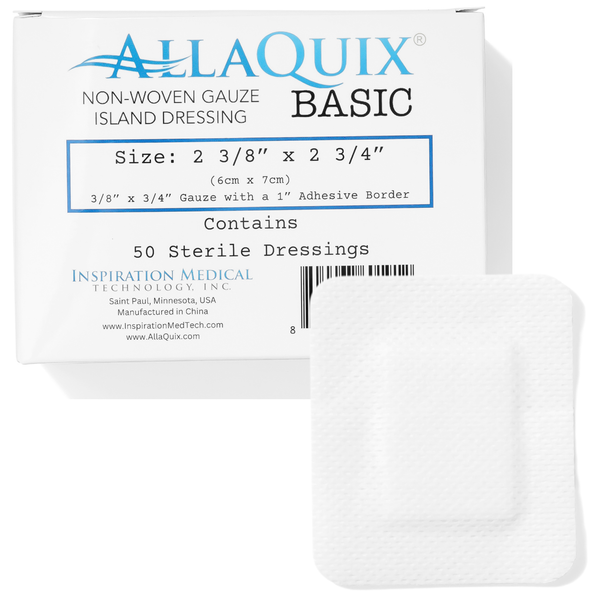
SMALL ISLAND DRESSING
AllaQuix® Basic Small Island Dressing
A soft non-adherent pad inside a 1 inch adhesive border, sized for small incisions, fingers and IV catheter sites. Sterile and latex-free. Box of 50 or a case of 20 boxes.
Best for: small incisions, IV sites, fingers
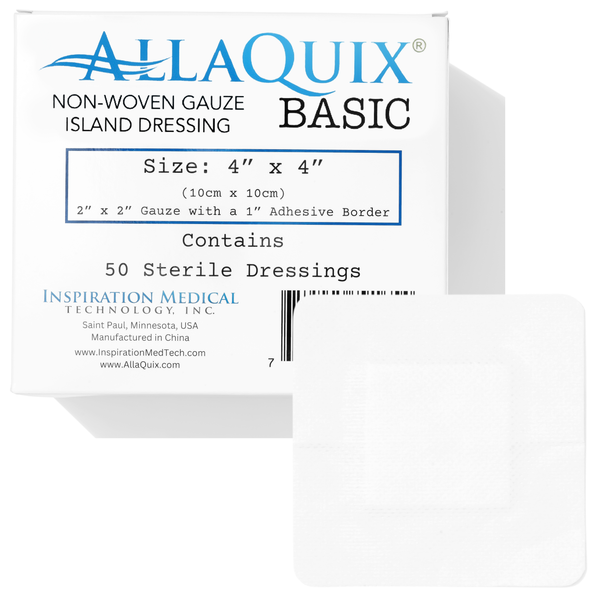
ISLAND DRESSING · 4×4
AllaQuix® Basic Island Dressing 4 × 4
A 2×2 inch non-adherent pad inside a 1 inch adhesive border. Sterile, latex-free and breathable. Box of 50 or a case of 12 boxes.
Best for: incision sites, everyday cuts, light to moderate drainage
How long to keep stitches covered
Most people keep stitches covered until they come out, or until the wound is dry and closed. How long that takes depends on where the stitches are. These are typical removal times. Your clinician will give you yours.
Typical time until stitches come out
- Face: about 3 to 5 days
- Scalp: about 7 to 10 days
- Arms, chest and abdomen: about 7 to 14 days
- Legs and feet: about 10 to 14 days
- Over joints: about 14 days
Can you get stitches wet?
Most doctors allow a brief shower after 24 to 48 hours. Let the water run over the stitches, don't scrub, and pat the area dry with a clean towel. Then put on a fresh dressing if you're still covering them.
Soaking is different. Baths, pools, hot tubs and swimming usually wait until the stitches are out and the wound has closed. That applies at day 7 too: a shower is usually fine, a soak usually isn't.
How to cover stitches
An island dressing is the simplest cover: a pad over the stitches and an adhesive border on the skin around them, with no tape on the stitch line.
The routine
- Wash your hands.
- Clean the area if your doctor told you to, then pat dry.
- Pick a size whose pad covers every stitch, with the border on healthy skin.
- Center the pad over the stitches and smooth the border outward.
- Change it daily, or when it gets wet or dirty.
- To remove it, peel low and slow toward the stitches, not away from them.
When to call your doctor
Check the stitches each time you change the dressing.
Call your doctor if you notice
- Redness that spreads outward, or red streaks
- Warmth, swelling or pain that gets worse instead of better
- Pus, cloudy drainage or a bad smell
- A fever of 100.4°F (38°C) or higher
- Stitches that come out early, or edges that pull apart
For bleeding you can't control with firm pressure, call 911.
FAQ
Common questions on this topic
Do you keep stitches covered until they're removed?
Often, yes, especially while the wound drains or rubs on clothing. Many doctors let you leave stitches uncovered once the wound is dry and closed. Follow the instructions you were given.
Should I cover my stitches at night?
Covering them at night keeps bedsheets from rubbing or catching on the stitches, and keeps the area clean. Most people keep a light dressing on overnight while the wound heals.
Can I get my stitches wet after 7 days?
A brief shower is usually fine well before that. Soaking in a bath, pool or hot tub usually waits until the stitches are out and the wound has closed.
Why do some doctors say no antibiotic ointment on stitches?
Many dermatologists recommend plain petroleum jelly instead, because antibiotic ointments can cause skin allergies in some people. Use what your doctor recommends.
When can I leave my stitches uncovered?
Usually once the wound is dry, closed and not draining, and it's not in a spot that gets dirty or rubbed. Ask your doctor if you're not sure.
COVER THEM RIGHT
Dressings sized for stitches, box or case
General wound care education, not medical advice. Always follow your doctor's instructions. Not for emergency, arterial, or severe bleeding.
Dallas, Texas
FDA reviewed and cleared. Nearly one million AllaQuix® sold.