
Laparoscopic Incision Care and Healing Stages
What normal healing looks like, how to care for the belly button incision, and the small dressings that fit port sites.
Reviewed by Inspiration Medical Technology, Inc. All articles are reviewed for accuracy and brand-voice compliance by the team behind AllaQuix®. Not a substitute for medical advice from your doctor.
What a laparoscopic incision is
In laparoscopic (keyhole) surgery, the surgeon works through small incisions called port sites, usually about ¼ to ½ inch long. One is often at or inside the belly button for the camera, with two to four more across the abdomen.
Port sites are usually closed with dissolvable stitches under the skin, skin glue, or adhesive strips. That closure changes the care a little, so check your discharge sheet for which you have.
Normal laparoscopic incision healing
Small incisions heal on roughly the same timeline as larger ones, just with less to watch. Here's what most people can expect.
Healing timeline
- Days 1 to 3: mild soreness, a little bruising, and a small amount of pink or clear fluid. Shoulder pain from the gas used during surgery is common and usually eases within a few days.
- Days 4 to 7: tenderness eases and the edges look sealed, with a thin scab or glue film.
- Weeks 2 to 3: glue and strips loosen and fall off. The incisions look pink and flat or slightly raised.
- Weeks 4 to 6: most people are back to normal activity once cleared. The marks start to fade.
- Months 3 to 12: the scars flatten and lighten.
Belly button incision care
The belly button incision is the one people worry about most. It sits in a fold that holds moisture and lint, so it can stay damp longer and look worse than the others while it heals normally.
Keep it clean and dry. When your surgeon clears you to shower, let soapy water run over it, rinse, and then pat the fold completely dry with a clean towel or gauze. Don't pack the belly button or dig into it with cotton swabs unless you've been told to.
Belly button incision: what's usually normal
- Bruising around the navel
- A little clear or pink fluid in the first few days
- A small firm ridge under the skin as it heals
- Mild itching
SMALL INCISIONS
Small island dressings for port sites
A soft non-adherent pad inside a 1 inch adhesive border. No tape needed.
SMALL ISLAND DRESSING
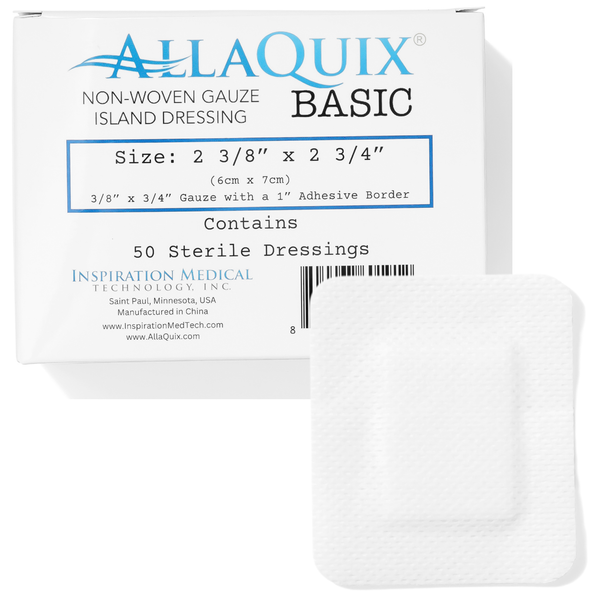
AllaQuix® Basic Small Island Dressing
A soft non-adherent pad inside a 1 inch adhesive border, sized for small incisions, fingers and IV catheter sites. Sterile and latex-free. Box of 50 or a case of 20 boxes.
Best for: small incisions, IV sites, fingers
ISLAND DRESSING · 4×4
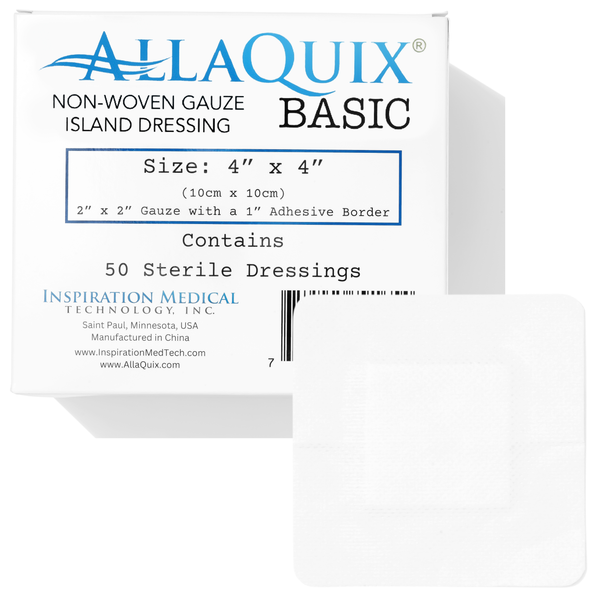
AllaQuix® Basic Island Dressing 4 × 4
A 2×2 inch non-adherent pad inside a 1 inch adhesive border. Sterile, latex-free and breathable. Box of 50 or a case of 12 boxes.
Best for: incision sites, everyday cuts, light to moderate drainage
Dressings for laparoscopic incisions
If your surgeon wants the incisions covered, size matters: the pad should cover the incision and the border should sit on healthy skin. The AllaQuix® Basic small island dressing is 2⅜ × 2¾ inches with a non-adherent pad, sized for port sites. The 4 × 4 covers a slightly longer incision or a deep belly button.
If your incisions were closed with skin glue, many surgeons ask you to leave them uncovered. A dressing can still help where a waistband rubs. The Basic line is designed to protect the wound to allow faster healing.
Dressing change routine
- Wash your hands.
- Peel the old dressing toward the incision, low and slow.
- Look at the incision: color, fluid, and whether the edges are closed.
- Clean only if you've been told to, then pat dry.
- Apply a fresh sterile dressing so the pad covers the incision.
- Change it daily or when it gets wet, unless told otherwise.
When to call your surgeon
Check each incision when you change the dressing. Problems are easier to treat when they're caught early.
Call your surgical team if you notice
- A fever of 100.4°F (38°C) or higher
- Redness that spreads outward from the incision, or red streaks
- Warmth, swelling or pain that gets worse instead of better
- Cloudy, yellow or green drainage, or a bad smell
- Edges that pull apart or an incision that opens
- Bleeding that soaks through the dressing. Press firmly over the dressing and call.
- Belly pain that gets worse instead of better
- Vomiting, or you can't keep fluids down
For trouble breathing, chest pain, or bleeding you can't control with pressure, call 911.
FAQ
Common questions on this topic
How long do laparoscopic incisions take to heal?
The surface usually closes in one to two weeks. The scars keep fading and flattening for several months.
Is it normal for my belly button incision to leak?
A little clear or pink fluid in the first few days is common. Cloudy, yellow or green drainage, a bad smell, or drainage that starts later is not. Call your surgeon.
Should I cover my laparoscopic incisions?
Follow your surgeon's instructions. Many teams ask you to keep them covered for the first day or two and while they drain, and to leave glued incisions uncovered. A small island dressing protects them from waistbands.
When can I shower after laparoscopic surgery?
Often after 24 to 48 hours, but ask first. Let water run over the incisions, don't scrub, and pat them dry, especially the belly button.
Why does my shoulder hurt after laparoscopy?
The gas used to inflate the abdomen during surgery can irritate a nerve that refers pain to the shoulder. It usually eases within a few days. Chest pain or trouble breathing is different: call 911.
BEFORE YOUR PROCEDURE
Pick up small dressings before surgery day
General patient education, not medical advice. Always follow your surgeon's instructions. Not for emergency, arterial, or severe bleeding.
Dallas, Texas
FDA reviewed and cleared. Nearly one million AllaQuix® sold.