Nosebleed at School: A Practical Protocol for Nurses, Teachers, and Coaches
A kid with a nosebleed in the middle of third period is one of the most common things a school nurse sees, and one of the most commonly handled wrong by the teacher or coach who gets to the kid first. Tilt the head back. Stuff with toilet paper. Lie down. Three pieces of common-sense advice, three reasons the bleed lasts longer than it had to. This guide is a practical nosebleed-at-school protocol: what the nurse should do, what staff outside the health office should know, and what to send home in the kid's note.
Written for school nurses, teachers, athletic trainers, coaches, and front-office staff. Print it. Tape it inside the first-aid cabinet.
The 4-step protocol
- Sit the student up and forward. Not back. Lean slightly forward over a tissue, sink, or trash can. Leaning forward keeps blood out of the throat and stomach, which is the part that makes kids vomit and panic.
- Pinch the soft part of the nose: just below the bony bridge, all the way against the septum. Both nostrils, even if only one is bleeding. Pinch firmly enough that the student can't breathe through the nose at all.
- Hold for a full 10 minutes by a clock. No peeking. Set a timer or use the wall clock. Every peek to check restarts the clock and tears any forming clot.
- If the bleed hasn't stopped after one full 10-minute round, insert a hemostatic nose plug (calcium alginate) into the bleeding nostril and continue pinching for another 5–10 minutes. If still bleeding after that, see escalation below.
That's the protocol. Done correctly, it stops the vast majority of school nosebleeds in under 15 minutes.
What teachers and coaches should do before the nurse arrives
The first 90 seconds before the kid gets to the health office matter. The simple-language version every staff member should know:
- Sit the student up. Lean forward. Not back.
- Pinch the soft, fleshy part of the nose firmly. Hold for 10 minutes.
- Don't have them lie down. Don't pack the nose with toilet paper.
- If the kid is panicking, the calm tone matters as much as the technique. "This is going to be fine, we have a system" works better than "uh oh."
- Send a staff member with them to the office if the bleed is heavy. Don't send a bleeding kid down the hall alone.
For high-frequency-incident sports (football, basketball, wrestling), the athletic trainer should have the same protocol in their bag with the same expected response time.
The hemostatic nose plug: the upgrade most school health offices don't have
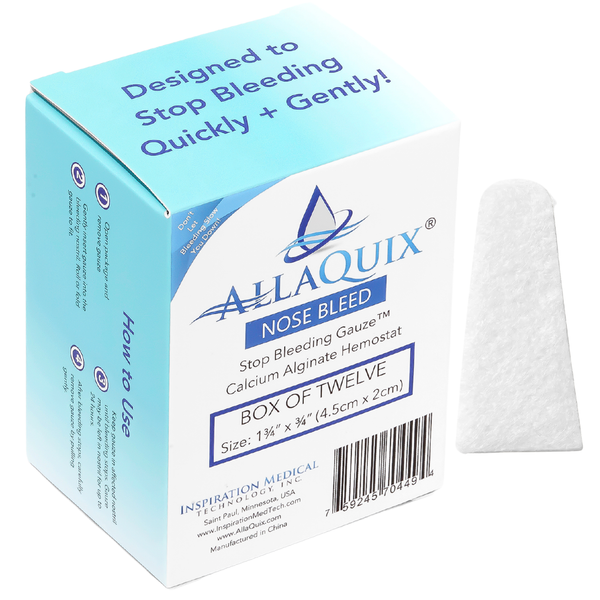
A hemostatic nose plug is a small, pre-shaped, single-use calcium alginate plug designed for the nasal cavity. The school nurse use case is the textbook fit:
- The stubborn nosebleed that's gone past the first 10-minute window.
- The kid on an anticoagulant or with a known bleeding disorder.
- The repeat-customer nosebleeder who's burning class time every other week.
- The football game-day nosebleed where the trainer needs the athlete cleaned up fast.
The plug is inserted, the soft part of the nose is pinched normally around it, and removal once bleeding has stopped is clean: no tearing the forming clot off the way a tissue does.
For school health offices: AllaQuix® Nose Bleed Gauze is a 12-count box of single-use calcium alginate nose plugs sized for school-age kids and adults. For full school nurse kit evaluation, the AllaQuix® School Nurse Sample Box bundles nose plugs with calcium alginate adhesive bandages and pads, sized and priced for a year of typical health-office traffic.
What to skip: the common school-protocol mistakes
- Tilting the head back. Old advice, wrong advice. Sends blood into the throat and stomach. Causes nausea and vomiting.
- Lying flat. Same problem, worse.
- Stuffing toilet paper or tissue up the nose. Tissues stick to forming clots. When removed, the clot comes off and the bleed restarts.
- Pinching the bony bridge instead of the soft part. Wrong location, wrong vessels. Pinching the soft part below the bridge is what compresses Kiesselbach's plexus, where 90% of nosebleeds originate.
- Letting the kid blow the nose mid-bleed. Dislodges any partial clot.
- Checking every 30 seconds. Resets the 10-minute clock.
When to call the parent vs. when to send home vs. when to call 911
- Stops within 10–15 minutes. Standard school protocol. Note in the health record. Send a "nosebleed at school" note home so the parent knows. No follow-up needed unless the kid is a repeat.
- Stops after 15–25 minutes with hemostatic plug. Call the parent for awareness, especially if the kid has had multiple recent nosebleeds. Discuss whether a pediatrician check is warranted.
- Still bleeding after 25–30 minutes despite correct protocol. Call the parent for pickup and recommend urgent care.
- Bleeding accompanied by significant blood loss (multiple soaked tissues, light-headedness, dizziness, paleness), or following a head injury, or in a student with a known bleeding disorder: 911. Do not wait.
- The student is on a blood thinner (uncommon but increasing in older students with cardiac conditions, and in adult staff): faster escalation. Hemostatic plug at 5 minutes, parent call at 15, urgent care at 20.
The repeat-customer nosebleeder
Every school has 2–3 students per year who account for a disproportionate share of the health-office nosebleed visits. Most have dry-air-driven nosebleeds that follow a predictable seasonal pattern. The protocol for these students:
- Document the visit pattern. Date, frequency, side, duration, what stopped it.
- Send a "discuss with pediatrician" note home if visits exceed once a week for two weeks running.
- Recommend dry-air prevention at home: cool-mist humidifier in the bedroom, thin smear of plain petroleum jelly inside each nostril at bedtime, saline spray in dry seasons.
- Provide the family with a small box of hemostatic nose plugs for at-home use to cut the timeline on after-school bleeds.
For a small number of students, the pediatrician may recommend cauterization at an ENT, particularly if the nosebleeds are originating from a single visible vessel in the front of the nose.
The blood thinner adult staff scenario
Adult staff with cardiac conditions are increasingly on anticoagulants: Eliquis, Xarelto, warfarin, aspirin, Plavix. A nosebleed in a staff member on a thinner takes longer and warrants faster escalation:
- Same physical protocol: sit up, lean forward, pinch the soft part.
- Insert a hemostatic plug earlier, at the 5-minute mark, not after a full 15-minute round of pressure.
- Call EMS or recommend urgent-care transport if not slowing after 20 minutes, or if the staff member is on dual antiplatelet therapy.
- Always inform the responding clinician what anticoagulant the staff member takes and the most recent dose.
Documenting the visit
Every nosebleed visit gets a brief health-office record entry:
- Date and time.
- Student / staff name.
- Side (left, right, both).
- Duration before stopping.
- Method (pressure only, plug, other).
- Disposition (returned to class, sent home, urgent care).
- Notes: recent nosebleeds, known medical conditions, anticoagulant status for staff.
This is the data that turns a string of one-offs into a pattern you can discuss with the parent or with the staff member's physician.
Restocking the school health office
Once-a-semester audit of the nosebleed-specific supplies:
- Hemostatic nose plugs: at least one full box on hand. Replace as used.
- Sterile gauze pads: 2"x2" and 4"x4".
- Tissues (not for nasal packing, for face cleanup after the bleed).
- Disposable gloves: universal precautions.
- Saline spray: for the dry-nose preventer.
- Plain petroleum jelly: for take-home recommendations.
- A clock or visible timer in the area where bleeds are managed. Critical.
Frequently asked questions
Why not pack the nose with tissue?
Tissues stick to the forming clot. When the tissue is removed, the clot comes off with it and the nose starts bleeding from the same point. A hemostatic plug avoids this; it gels in place and removes cleanly.
Should the kid lie down to rest after a nosebleed?
No. Sitting upright is the correct position. Lying down sends blood down the throat and can cause nausea even after the bleed has stopped.
Is it safe to use a hemostatic nose plug on a kid?
Calcium alginate is widely used pediatrically. For young children under 5, follow the AllaQuix® Nose Bleed product guidance and call the parent / pediatrician for ongoing concerns. For school-age kids and adults, the plug is the standard of care for nosebleeds not stopping with pressure.
What if the kid keeps having nosebleeds during the same week?
Document the pattern, recommend a pediatrician check. Most repeat nosebleeds are dry-air-driven and respond to a humidifier and nasal moisture; a small minority indicate a bleeding disorder or anatomical issue that needs evaluation.
Does the school need a written nosebleed protocol?
Yes, both for liability and for consistency. Most school nurse offices include a nosebleed protocol in the general health-office procedures manual. This article is a starting template; adapt to your specific district's policies.
Can teachers handle nosebleeds without sending kids to the nurse?
For straightforward, brief nosebleeds: yes, with the basic protocol. For anything not stopping in 10 minutes, anything with significant blood loss, or any student with known medical conditions: send to the nurse.
The bottom line. Sit up, lean forward, pinch the soft part, hold 10 minutes. If it isn't stopping, hemostatic plug for another 5–10 minutes. Document everything, call the parent at the appropriate threshold, send the repeat-customer students home with prevention recommendations. The supplies that make this fast: a box of nose plugs, a visible clock, and a calm voice.
Request an AllaQuix® School Nurse Sample Pack →
This article is informational and not a substitute for medical advice or your district's specific health-office protocols. AllaQuix® Nose Bleed Gauze is a sterile, single-use calcium alginate dressing intended for minor nasal bleeding. Not for emergency or severe bleeding.