
When to Stop Covering a Wound
Signs it's ready to go uncovered, why covered wounds tend to heal better, and when to see a doctor.
Reviewed by Inspiration Medical Technology, Inc. All articles are reviewed for accuracy and brand-voice compliance by the team behind AllaQuix®. Not a substitute for medical advice from your doctor.
When can you stop covering a wound?
You can usually stop covering a minor wound once the surface has closed with new pink skin, there's no drainage, and it's not in a spot that rubs or gets dirty. Until then, keep it covered.
Why covered wounds tend to heal better
Letting a wound breathe is a common idea, but a wound that dries out forms a hard scab that new skin has to grow under. A covered wound with a thin layer of petroleum jelly stays lightly moist, which tends to mean less scabbing and a smaller scar.
A dressing also keeps out dirt, absorbs drainage and protects the wound from bumps and clothing. The AllaQuix® Basic line is designed to protect the wound to allow faster healing.
WHILE IT HEALS
Sterile dressings for healing wounds
A non-adherent pad inside a 1 inch adhesive border. Box of 50 or a case.
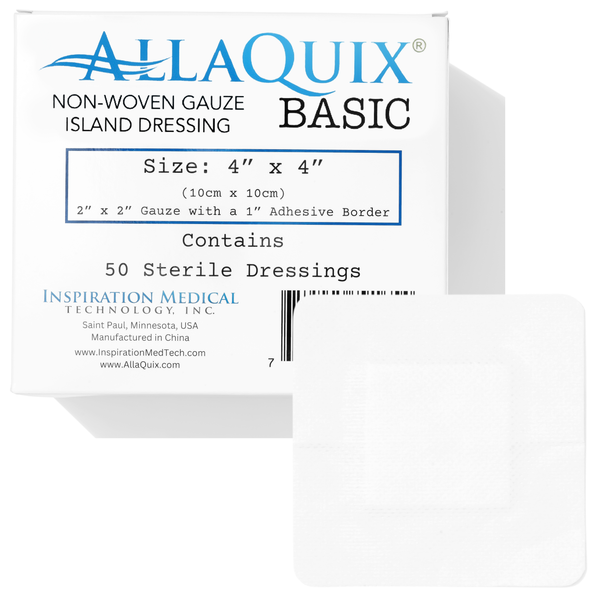
ISLAND DRESSING · 4×4
AllaQuix® Basic Island Dressing 4 × 4
A 2×2 inch non-adherent pad inside a 1 inch adhesive border. Sterile, latex-free and breathable. Box of 50 or a case of 12 boxes.
Best for: incision sites, everyday cuts, light to moderate drainage
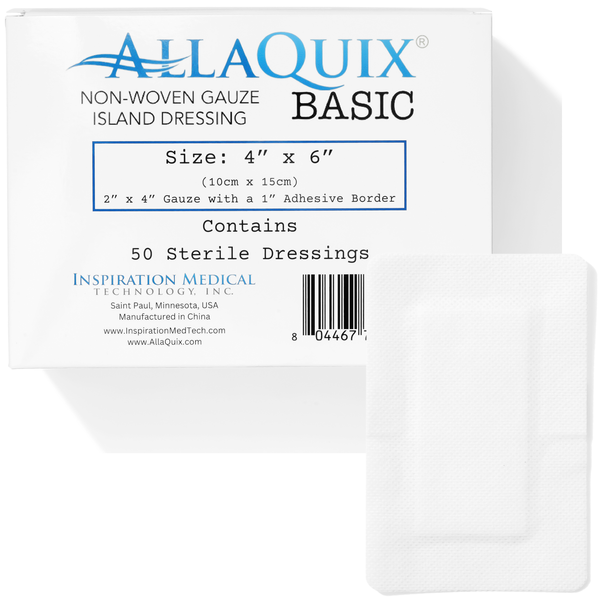
ISLAND DRESSING · 4×6
AllaQuix® Basic Island Dressing 4 × 6
A 2×4 inch pad inside a 1 inch adhesive border, for longer incisions and larger areas. Box of 50 or a case of 12 boxes.
Best for: longer incisions, larger cuts
Signs a wound is ready to go uncovered
Check each time you change the dressing.
Ready when
- The surface is closed, with no raw or open spots
- There's no fluid on the pad at the last change
- The new skin is pink and smooth
- It's not on a hand, foot or other spot that gets dirty or rubbed
Keep covering it if
Some wounds need a dressing longer.
Keep covering if
- It's still weeping or damp
- Any part is still raw or open
- It rubs on clothing, shoes or bedding
- It's on your hands or feet and gets dirty
- You still have stitches, staples or strips
How to change a dressing on a healing wound
Pick a dressing whose pad is bigger than the wound, so the adhesive only touches healthy skin.
The routine
- Wash your hands.
- Peel the old dressing low and slow toward the wound. Dampen it if it sticks.
- Rinse the wound with clean water and pat the skin around it dry.
- Apply a thin layer of petroleum jelly if your doctor recommends it.
- Center a fresh sterile dressing over the wound and smooth the border.
- Repeat daily, or when the dressing gets wet or dirty.
When to see a doctor
Home care is for minor cuts and scrapes. Get medical care for any of these.
See a doctor for
- A cut that gapes open or may need stitches
- A deep wound, or one with dirt or debris you can't rinse out
- Animal or human bites, or puncture wounds from rusty objects
- Bleeding that won't slow with firm pressure
- Spreading redness, warmth, pus or fever
- A wound that isn't improving after a week or two
People with diabetes or poor circulation should have a lower threshold for calling a doctor.
FAQ
Common questions on this topic
Should I let a wound breathe at night?
Most minor wounds heal better covered, day and night, until the surface has closed. A light dressing at night also keeps bedding from rubbing it.
Should I cover a scab?
If the wound has already scabbed, covering it protects the scab from being knocked off. Don't pick it.
When should I stop putting petroleum jelly on a wound?
Usually once new skin has closed over the wound. Some doctors suggest continuing on a healing scar for a while. Follow your doctor's advice.
How long does a minor wound take to heal?
A small cut or scrape often closes in about a week. Larger or deeper wounds can take two weeks or more.
Is it OK to leave a wound uncovered?
Once it's closed, dry and not in a spot that gets dirty or rubbed, yes.
KEEP IT COVERED
Sterile dressings for every size of wound
General wound care education, not medical advice. Always follow your doctor's instructions. Not for emergency, arterial, or severe bleeding.
Dallas, Texas
FDA reviewed and cleared. Nearly one million AllaQuix® sold.