
Abrasion Wound Care: How to Clean and Cover a Scrape
How to rinse out the grit, keep a scrape moist and covered, and tell when an abrasion needs a doctor.
Reviewed by Inspiration Medical Technology, Inc. All articles are reviewed for accuracy and brand-voice compliance by the team behind AllaQuix®. Not a substitute for medical advice from your doctor.
What an abrasion is, and how deep yours is
An abrasion removes skin by friction rather than cutting through it. Because it's wide rather than deep, it exposes a lot of nerve endings, which is why a scrape can hurt more than a small cut. Road rash, floor burns, and skinned knees and elbows are all abrasions.
How deep is it?
- Surface scrape: pink and raw, little bleeding, some clear fluid. Heals at home, usually in about a week.
- Deeper abrasion: red, oozing, sometimes with dirt pressed into it. Usually fine at home with careful cleaning, and takes one to two weeks.
- Deep abrasion: white or yellow tissue showing, or skin missing down to the fat. This needs a clinician.
How to clean an abrasion
Cleaning is the most important part of abrasion care. Grit left in a scrape raises the risk of infection and can leave a permanent dark mark in the skin.
The cleaning routine
- Wash your hands.
- Press gently with clean gauze if it's oozing blood, until it settles.
- Rinse under clean running water for several minutes.
- Lift out remaining grit with clean tweezers or a damp gauze pad.
- Wash the skin around it with mild soap, and rinse again.
- Pat dry around the scrape with a clean towel.
Skip hydrogen peroxide, rubbing alcohol and iodine. They damage the new tissue trying to grow in.
What to put on a scrape
Scrapes heal best when they stay moist and covered. Letting a scrape air out makes a hard scab that cracks and slows healing. A thin layer of plain petroleum jelly keeps the surface moist. Most scrapes don't need an antibiotic ointment, and some people react to them.
Then cover it with a dressing whose pad won't stick. An island dressing is a good fit: a soft non-adherent pad over the scrape and an adhesive border on healthy skin, so there's no tape on the raw area. For a scrape that keeps oozing blood, especially on a blood thinner, a hemostatic gauze with firm pressure helps first.
COVER IT
Non-stick island dressings for scrapes
A soft pad over the scrape and an adhesive border on healthy skin. Sterile, latex-free, box or case.
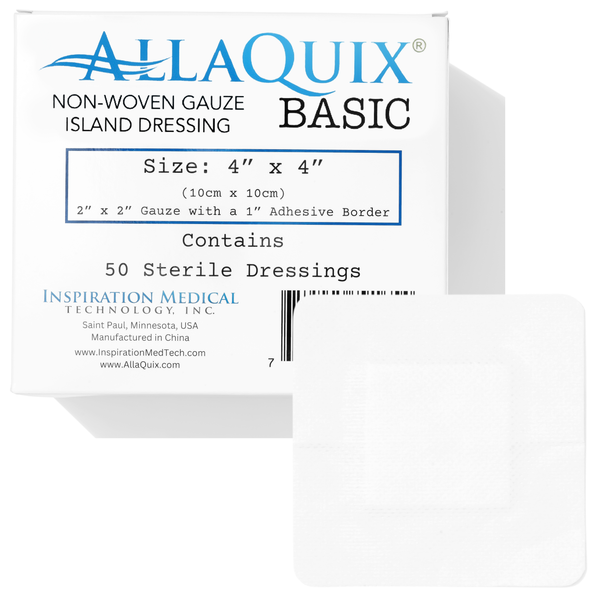
ISLAND DRESSING · 4×4
AllaQuix® Basic Island Dressing 4 × 4
A 2×2 inch non-adherent pad inside a 1 inch adhesive border. Sterile, latex-free and breathable. Box of 50 or a case of 12 boxes.
Best for: incision sites, everyday cuts, light to moderate drainage
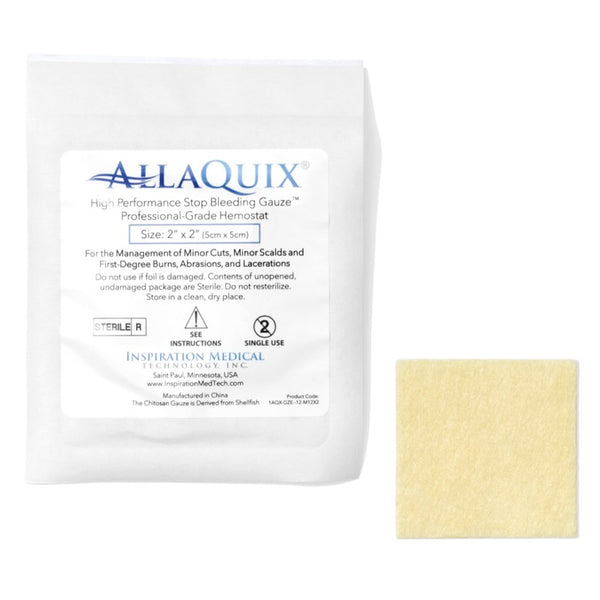
CHITOSAN
AllaQuix® High Performance 2 × 2
Chitosan gauze that attracts red blood cells to form a mechanical seal, independently of the clotting cascade. The same technology used by the U.S. Military.
Best for: minor cuts and abrasions that keep oozing, blood thinner users
When the top layer of skin is ripped off
If a flap of skin is still attached, don't cut it off. Rinse it, then gently lay it back over the raw area as close to its original position as you can, and cover it with a non-stick dressing. That flap is the best cover the wound can have.
In older adults with thin skin, this is usually a skin tear, and it needs extra care when the dressing comes off. See how to treat a skin tear on thin skin.
Changing the dressing and healing time
Change the dressing once a day, or sooner if it gets wet or soaked through. If it sticks, dampen it with clean water before lifting. Rinse the scrape, add a fresh thin layer of petroleum jelly, and re-cover.
Surface scrapes usually heal in 3 to 7 days, and deeper ones in 1 to 2 weeks. New skin is pink and tender for a while. Keep it out of strong sun for a few months to reduce darkening.
BIGGER AND SMALLER SCRAPES
Sizes for knees, elbows and fingertips
From a fingertip bandage to a 4 × 6 island dressing.
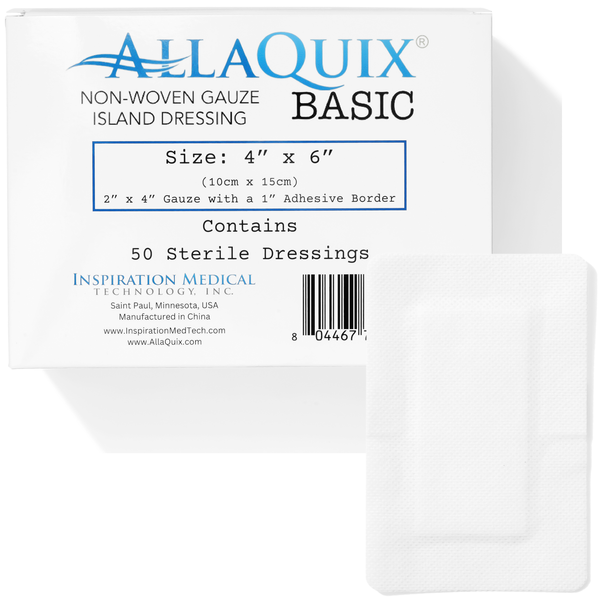
ISLAND DRESSING · 4×6
AllaQuix® Basic Island Dressing 4 × 6
A 2×4 inch pad inside a 1 inch adhesive border, for longer incisions and larger areas. Box of 50 or a case of 12 boxes.
Best for: longer incisions, larger cuts

CALCIUM ALGINATE BANDAGE
AllaQuix® Lite Adhesive Bandages
Calcium alginate bandages that gel on contact and absorb up to 20 times their weight. Hypoallergenic, no burning or stinging, gentle on thin or fragile skin.
Best for: fragile skin, blood thinner users, everyday cuts
When an abrasion needs a doctor
Most scrapes heal at home. See a clinician if you notice any of the following.
See a doctor if
- You can't get gravel or dirt out
- The scrape is deep, larger than your palm, or on the face
- It's over a joint and you can't move it normally
- It came from an animal or a very dirty surface and your tetanus shot isn't recent
- Redness spreads, it gets warmer or more painful, pus appears, or you get a fever
- It isn't clearly healing after two weeks, or you have diabetes or poor circulation
FAQ
Common questions on this topic
Should I let a scrape air out or keep it covered?
Keep it covered. Covered, moist wounds heal with less scabbing and usually less scarring than scrapes left to air out.
Should I put antibiotic ointment on a scrape?
Most scrapes do well with plain petroleum jelly. Antibiotic ointments aren't usually needed, and some people get a skin reaction to them.
How long does road rash take to heal?
Surface road rash usually heals in about a week. Deeper road rash can take two weeks or more. Road rash with embedded gravel should be cleaned by a clinician.
Why does a scrape hurt more than a cut?
A scrape exposes a wide area of nerve endings near the surface, while a small cut only affects a thin line of skin.
Do I need a tetanus shot for a scrape?
If the scrape is dirty and your last tetanus shot was more than five years ago, or a clean scrape and more than ten years ago, check with a clinician.
FOR THE FIRST-AID DRAWER
Keep non-stick dressings ready for the next scrape
Not for emergency, arterial, or severe bleeding. General patient education, not medical advice.
Dallas, Texas
FDA reviewed and cleared. Nearly one million AllaQuix® sold.