Nicked a Mole or Skin Tag That Will Not Stop Bleeding? What to Do
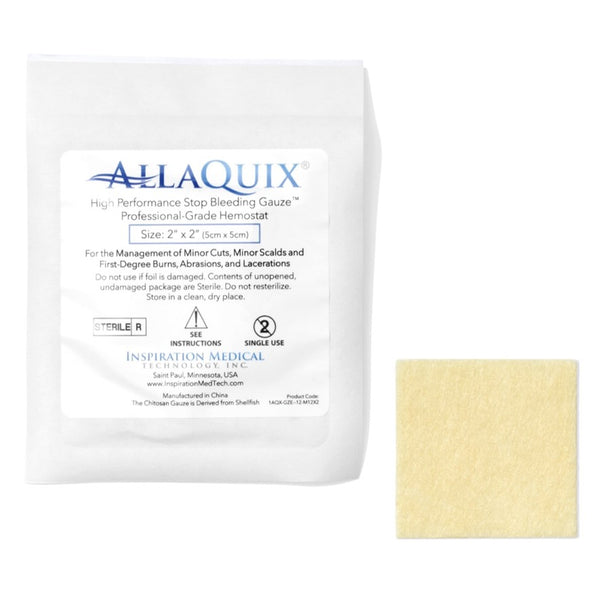
If you cut a mole shaving and it won’t stop bleeding, the fix is simple: rinse the spot, press a clean pad firmly over it, and hold without peeking, for 2 to 3 minutes with a hemostatic gauze such as AllaQuix® High Performance Stop Bleeding Gauze or a full 10 minutes with plain gauze, then cover it. A nicked mole or skin tag bleeds longer than flat skin because it is raised and has its own small blood supply, but it is still minor bleeding that responds to steady pressure. A mole that bleeds or changes on its own, without injury, should be looked at by a dermatologist.
Why does a nicked mole or skin tag bleed so much?
A nicked mole or skin tag bleeds longer than a flat scrape because the growth is raised, so a razor or fingernail slices through tissue instead of skimming the surface, and because these small growths carry their own supply of tiny blood vessels that keep feeding the cut until a clot can form and hold.
Skin tags are soft, harmless growths that often dangle from a narrow stalk and form where skin rubs against skin, jewelry, or clothing, according to the American Academy of Dermatology, which notes that “shaving can also irritate it, especially if you nick the skin tag.” The AAD’s page on when a mole is a problem says that when you shave over one, “you may nick the mole, causing it to bleed,” and files that under bothersome, not dangerous.
How do I stop a mole or skin tag from bleeding?
To stop a mole or skin tag from bleeding, wash your hands, rinse the spot with clean water, press a pad directly over it with firm, steady pressure, and keep pressing without lifting to look: 2 to 3 minutes with AllaQuix® High Performance chitosan gauze, or about 10 minutes with plain gauze, then cover the spot and keep it covered.
- Wash your hands and rinse the spot under cool running water; skip peroxide and alcohol, which sting and do nothing for bleeding.
- Place the pad over the whole spot. Set AllaQuix® High Performance Stop Bleeding Gauze directly against the bleeding surface; it can be cut or folded to fit a pea-sized mole. With plain gauze, fold a clean square several layers thick.
- Press firmly and do not peek. Hold High Performance for 2 to 3 minutes or until the bleeding stops; hold plain gauze 10 minutes by the clock. For a dangling skin tag, pinch the pad around the tag and its base.
- Check once. Still oozing? Press again. If blood soaks through and does not slow after 10 to 15 minutes of firm pressure, get medical care.
- Cover it. Leave High Performance gauze in place under tape or a wrap and remove it within 24 hours by soaking with water or saline so the clot is not disturbed.
- Keep it covered and moist for a day or two: petroleum jelly under a fresh adhesive bandage, changed daily or when wet, keeps a collar from reopening it.
Plain gauze, chitosan gauze, and alginate bandages for a small raised spot
For a small, awkwardly placed bleeding spot, AllaQuix® High Performance chitosan gauze offers the most stopping power, AllaQuix® Lite calcium alginate adhesive bandages offer the easiest one-handed application and the gentlest removal, and plain gauze works too, provided you hold it a full 10 minutes without checking.
The chitosan fibers in AllaQuix High Performance carry a positive charge that attracts negatively charged red blood cells and forms a seal over the wound, independently of the body’s clotting cascade (see how AllaQuix works). Chitosan dressings have been used by the U.S. Military, EMTs, and hospitals for over 20 years, and AllaQuix High Performance has been reviewed and cleared by the FDA for over-the-counter use on minor cuts, scalds, first-degree burns, abrasions, and lacerations. AllaQuix® Lite Calcium Alginate Adhesive Bandages are gentler and go on with one hand, but have less stopping power than chitosan gauze for stubborn bleeding.
| Dressing | How it helps stop bleeding | How long to hold | Fit on a small raised spot | Removal |
|---|---|---|---|---|
| Plain gauze | Covers and absorbs blood; does not actively help clot | About 10 minutes, no peeking | Fold thick; needs tape or a second hand | Can stick to the clot; soak before lifting |
| AllaQuix® High Performance (chitosan) | Positively charged fibers attract red blood cells and form a seal, independent of the clotting cascade | 2 to 3 minutes or until bleeding stops | Cut or fold to size; secure with tape or wrap | Within 24 hours; soak with water or saline first |
| AllaQuix® Lite adhesive bandage (calcium alginate) | Forms a soft gel; calcium ions help clotting; absorbs up to 20 times its weight | Gentle pressure until bleeding stops | Peel, apply, press with one hand | Gel lifts away without sticking; remove within 7 days |
Lite is not for dry wounds or alginate sensitivity; people with known shellfish allergies should use caution with any chitosan product.
What is different if I take a blood thinner?
If you take a blood thinner such as aspirin or Eliquis, a nicked mole or skin tag will usually bleed longer and restart more easily, so plan on holding pressure for the full time, keep a hemostatic gauze in the bathroom where you shave, and let your prescriber know if small cuts have started taking much longer to stop.
AllaQuix works independently of the body’s clotting cascade, so it works for people on blood thinners or with bleeding disorders. Our guide to whether Eliquis makes cuts bleed longer goes deeper, and thin skin that tears and bleeds easily covers the tag that comes off with a flap of skin. Medication decisions belong with your doctor, not a blog post.
How do I keep from nicking it again?
To avoid nicking a mole or skin tag again, shave around the growth rather than over it, use a fresh blade with a light touch, cover the spot with a small adhesive bandage before shaving or before wearing a collar or necklace that catches it, and ask a dermatologist about removal if it keeps getting caught.
- Map it before you lather and shave up to its edge from each side, leaving a small ring of stubble.
- Bandage first. Shave over a small adhesive bandage, or wear one under a strap or necklace that keeps snagging. An AllaQuix Lite adhesive bandage does both jobs.
- Do not remove it yourself. The AAD advises against at-home skin tag removal products, noting the FDA has not approved any of them; snipping or tying off a tag at home risks a bigger bleed and infection.
- Ask about removal. The AAD says a dermatologist can remove a mole that is easily irritated or a skin tag that becomes irritated or bleeds.
Should I see a doctor if a mole bleeds after I cut it?
A mole that bleeds because you cut it shaving does not need a doctor for that alone, and nicking a mole does not cause skin cancer, but a mole that bleeds on its own, itches, changes in size, shape, or color, or becomes a sore that does not heal should be examined by a dermatologist, according to the AAD.
The AAD calls a nicked or snagged mole bothersome, not a warning sign. What it does flag: “A bleeding or itchy mole can be a sign of melanoma,” and “if a mole looks different from the others, itches, bleeds, or is changing in any way, a dermatologist should examine it.” The Skin Cancer Foundation teaches five letters: A for asymmetry, B for an uneven or notched border, C for multiple colors, D for a diameter larger than a pencil eraser, and E for evolving, “any change in size, shape, color or elevation of a spot on your skin.” It adds that “a sore or spot that does not heal” and any new symptom “such as bleeding, itching or crusting” are reasons to see a dermatologist promptly. This article cannot tell you what a spot is; only an exam can.
Urgent care is for blood that soaks through and does not slow after 10 to 15 minutes of firm pressure, spurting blood, a deep or gaping cut, or a growth torn mostly off; severe, heavy, or uncontrolled bleeding is a 911 call. Spreading redness, warmth, or pus afterward point to infection and deserve a visit.
Shaving around a mole or skin tag is far less stressful when the fix is within reach of the sink. AllaQuix® High Performance Stop Bleeding Gauze 2"x2" handles the stubborn bleeder in 2 to 3 minutes, and AllaQuix® Lite Calcium Alginate Adhesive Bandages cover and protect the spot afterward. Keep both in the bathroom, and let a dermatologist see any mole that bleeds without a reason.
Frequently Asked Questions
I cut a mole shaving and it won’t stop bleeding. What should I do?
Rinse it, press a pad firmly over the mole, and hold without lifting to look: 2 to 3 minutes with AllaQuix High Performance chitosan gauze or 10 minutes with plain gauze, then cover it. If it soaks through and does not slow after 10 to 15 minutes of pressure, get medical care.
How do I stop a skin tag from bleeding?
Pinch a clean pad around the skin tag, including the base where it joins the skin, and hold steady pressure for 2 to 3 minutes with hemostatic gauze or 10 minutes with plain gauze without peeking.
Does nicking a mole while shaving cause skin cancer?
No. The American Academy of Dermatology describes a nicked or snagged mole as bothersome, not a cancer sign. A mole that bleeds or itches on its own, looks different from the others, changes, or does not heal should be checked by a dermatologist.
Can I use AllaQuix on a mole or skin tag if I take Eliquis or aspirin?
Yes. AllaQuix High Performance works independently of the body’s clotting cascade, so it works for people on blood thinners or with bleeding disorders. Expect the spot to bleed longer, hold pressure for the full time, and never change your medication without talking to your doctor.
Should I remove a skin tag myself if it keeps bleeding?
No. The AAD advises against at-home skin tag removal products, noting the FDA has not approved any of them, and snipping or tying off a tag at home risks heavier bleeding and infection. A dermatologist can remove it in one visit.
This article is general information from the makers of AllaQuix® and is not medical advice. Talk to your doctor or another qualified health professional about your own health or medications. For severe, heavy, or uncontrolled bleeding, call 911 or seek emergency care.